
Troubleshooting a Loose TO-220 Silicone Cap: Reduce Air-Gap Resistance
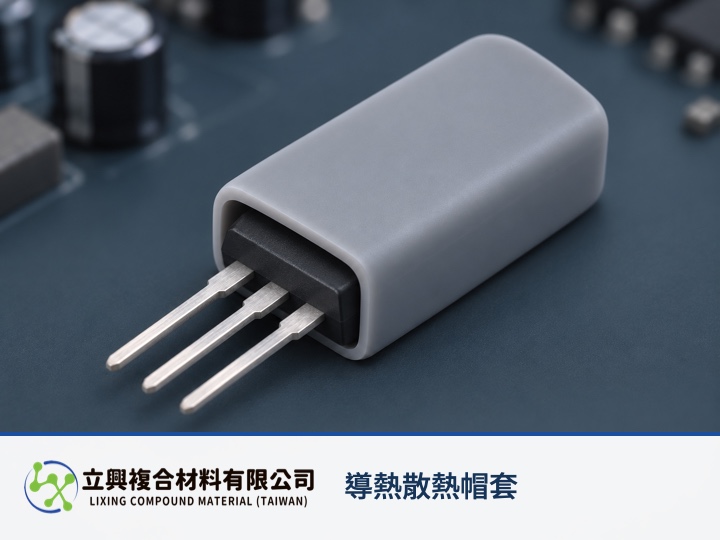
When a cap slides over a power component but its walls do not make consistent contact, the main benefit of a heat conductive silicone cap is still clear: it combines a thermal path, electrical insulation and physical coverage around one package. Engineers and buyers working with diodes, transistors and sensing components should remove loose-fit air gaps before evaluating the listed conductivity of 0.8–1.0 W/m·K.
Close the thermal path by checking package fit
A visible or unstable gap between the cap and a TO-220 body inserts a low-conductivity region into the heat path. The practical benefit comes from selecting a cap whose gray silicone walls follow the component profile. The Lixing product page lists TO-220A, TO-220B, TO-220C, TP-3PA and TP-3PB options, giving the engineer a package-based starting point.
Use air-gap resistance to interpret a loose fit
The engineering estimate is R_air = d_air / (k_air × A). R_air is air-gap thermal resistance in K/W, d_air is gap thickness in m, k_air is air conductivity in W/(m·K), and A is effective area normal to heat flow in m². At the same area, a thicker gap adds resistance. This NASA thin-air-gap model applies to steady, approximately one-dimensional conduction with a reasonably uniform gap. Pressure, roughness, cap deformation and edge heat loss remain outside this simple estimate, so it cannot establish product temperature drop or service life. Read the theory source.
Combine thermal transfer and electrical insulation
The product page lists thermal conductivity of 0.8–1.0 W/m·K and withstand voltage above 4 kV. Those properties support power-component applications that need heat transfer and electrical separation in the same part. They do not guarantee the same temperature result in every assembly because a loose wall or a mismatched package changes effective contact area.
Define sample checks with temperature and mechanical data
The listed operating range is -40°C to +180°C, with Shore A hardness of 70 ± 5 and elongation above 160%. Buyers can send the measured package length, width, height, local protrusions and service temperature with a sample request. A cap that is tight on one wall and loose on the other calls for a package and cavity check before any conclusion about conductivity.
Keep compliance claims within the material scope
The official page lists UL 94 V-0/V-1 and RoHS, together with methods including ASTM D5470 and ASTM D149. A project should still confirm the required grade, batch documentation and finished-equipment conditions; a material-page rating is not a finished-device certification.
Start troubleshooting with a fitted sample
For diodes, transistors, sensing components and electrical parts that need heat dissipation, insulation and physical protection, measure the package and compare it with the TO-220A/B/C and TP-3PA/B options on the Heat Conductive Silicone Cap product page. When requesting a sample or specification consultation from Lixing Composite Materials Co., Ltd., provide the package variant, measured dimensions, service temperature and insulation requirement.