
Phase Change Thermal Pads Resist Pump-Out in Server Thermal Cycling
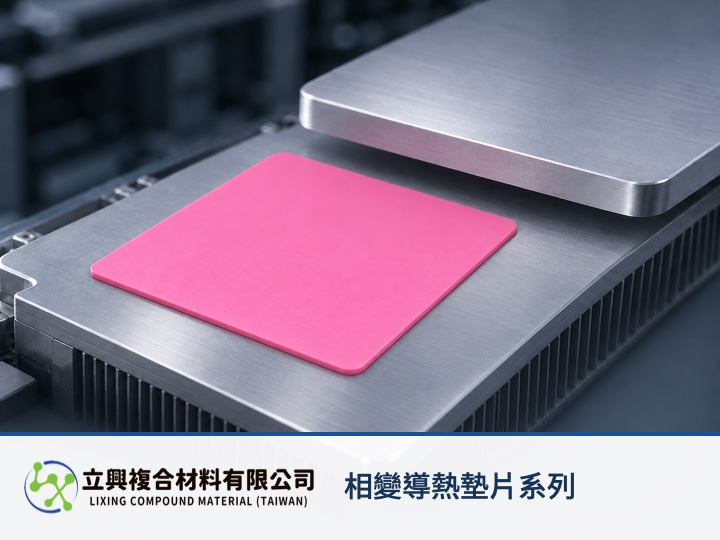
For servers and high-power modules that repeatedly heat and cool, the LXPCM Phase Change Thermal Pad can be die-cut and automatically placed as a solid sheet, then soften and wet the interface at 45°C to 55°C. The product page states that it avoids the pump-out and dry-out associated with conventional thermal grease, giving thermal engineers and buyers a clean, positionable interface material.
Solid placement keeps assembly controlled
LXPCM remains a solid sheet at room temperature for die cutting and automated placement. This form helps advanced electronics production control where the interface material sits without relying only on dispensed liquid volume.
Phase-change wetting reaches surface irregularities
At 45°C to 55°C, the material progressively softens and fills microscopic irregularities. The product page lists thermal conductivity of 4 W/m·K and thermal impedance of 0.08 °C·in²/W. Read those values together with ASTM D5470 conditions and the actual assembly pressure.
Why thermal cycling loads the interface
The linear thermal-expansion model is ΔL = αLΔT, where ΔL is length change, α is the coefficient of linear expansion, L is initial length and ΔT is temperature change. Chips, substrates and heat sinks have different α values, so cycling creates relative motion. The DOE engineering reference gives this relationship. It estimates uniform small-strain expansion and does not directly predict pump-out or service life.
A broad operating range supports high-heat equipment
The product page lists an operating range of -40°C to 125°C and describes no drying, cracking or sagging through long-term thermal cycling. Servers, high-power modules and EV inverters still require sample validation against flatness, pressure, temperature history and the customizable thickness.
Evaluate reliability in the actual stack-up
LXPCM combines solid placement with in-service interface wetting to address pump-out concerns. Server and power-module teams can send contact dimensions, thermal-cycle range, clamping method and thickness requirements to Lixing for samples and specification consultation.