
Conductive Cloth Tape or Copper Foil: Choose for Flexing and EMI Grounding
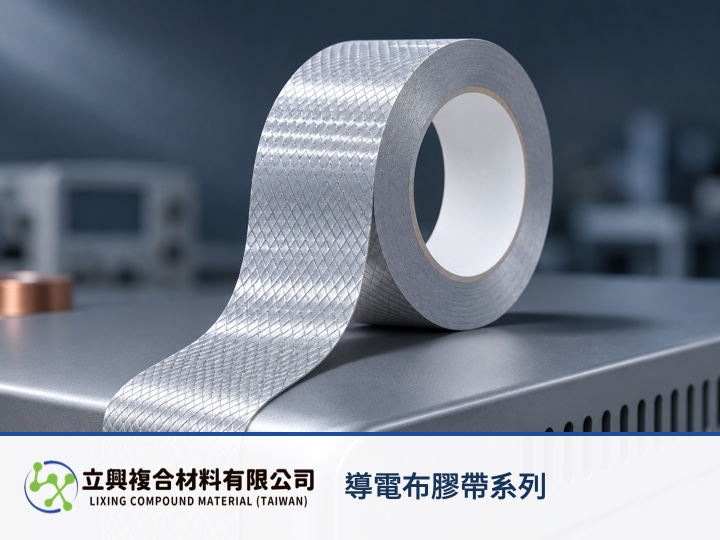
When an EMI grounding path must follow enclosure corners, flex cables, or irregular profiles inside precision electronics, flexible conductive cloth tape is easier to conform; copper foil remains a useful candidate on broad, flat areas where a continuous metal surface is the priority. The LX-DDB Conductive Cloth Tape Series combines 260T plain-weave conductive fabric with conductive acrylic adhesive and lists surface resistance at ≤ 100 mΩ, making it a candidate for EMI shielding and grounding prototypes.
Use fabric conformability on bends and irregular profiles
The soft fabric carrier can wrap corners, cables, and die-cut shapes, reducing the installation difficulty that a stiffer shielding tape may present at tight bends. This benefit follows the product page's verified wrapping and die-cutting statements. A broad, flat panel still warrants a copper-foil sample in the comparison.
Evaluate the material and the bonded joint together
LX-DDB lists surface resistance of ≤ 100 mΩ and 180-degree peel strength of ≥ 1.3 kgf/in. The resistance supports a conductive path, while adhesion helps maintain contact. Actual EMI performance also depends on overlap area, seams, enclosure pressure, and grounding points, so one material value cannot predict system-level shielding effectiveness.
Keep the process temperature inside the sample plan
The product page lists 80°C continuous operation and 120°C short-term temperature resistance. These values can screen candidates but do not replace thermal cycling, surface preparation, and post-assembly measurement. Share target temperature, dwell time, substrate surface, and bend radius when requesting a customized-thickness LX-DDB sample.
Engineering basis: frequency changes field penetration depth
The NIST good-conductor skin-depth model is δ = sqrt(2 / (ω μ σ)). Here δ is skin depth in metres, ω is angular frequency in rad/s, μ is permeability in H/m, and σ is conductivity in S/m. Under a homogeneous, linear, isotropic good-conductor plane-wave approximation, higher frequency or conductivity reduces penetration depth. The model omits adhesive layers, fabric anisotropy, seams, and overlap resistance, so it explains a selection principle but cannot calculate the shielding effectiveness of this product or a copper-foil assembly.
Route the two materials into different prototype questions
Engineers searching for custom plain-weave conductive fabric tape usually need the tape geometry and grounding path to fit a specific enclosure. Treat that phrase as a sourcing intent, then verify the actual carrier, adhesive, temperature window, and assembled contact rather than assuming every cloth tape behaves alike.
- Corners, cable wraps, and die-cut profiles: prioritize cloth-tape conformability and contact continuity.
- Broad, flat bonds: compare the continuous metal face of copper foil with its crease and installation risks.
- For either material, measure the assembled grounding path at the target frequency instead of treating the material name as validation.
Bring application constraints to sampling
Handheld wireless modules, laptops, automotive electronics, and LCD backlight modules place shielding materials in compact spaces where a grounding path may cross bends. LX-DDB's flexible plain-weave carrier and customizable thickness suit irregular wrapping requirements. Contact Lixing Composite Material Co., Ltd. with the target frequency, bonding surface, available thickness, temperature conditions, and die-cut outline so the sample can be tested in the actual assembly.