
Fiberglass Thermal Tape Saves Screw Space in LED Modules: Tape or Pad?
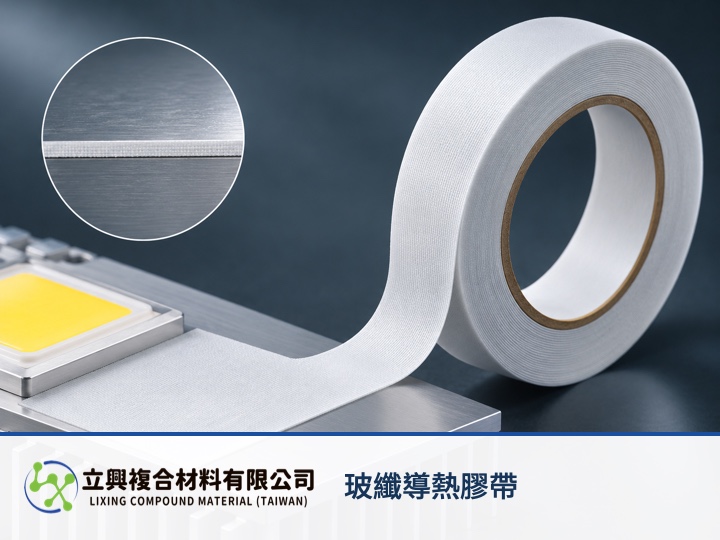
For a flat LED module or power board that must bond a heat source to a heat sink, H-GT-WH Fiberglass Thermal Conductive Tape provides heat transfer, fixation, and electrical insulation in a 0.095 ± 0.005 mm layer, preserving assembly space otherwise used by screws and a thicker pad. A thermal pad with screws remains the better route when surfaces have a visible gap, the assembly must be serviced, or controlled clamping force is required. Lighting buyers and thermal engineers can decide by reviewing gap, flatness, service method, and voltage-withstand needs.
A thin bond line preserves LED module space
H-GT-WH has a total thickness of 0.095 ± 0.005 mm. Its white fiberglass backing provides structural support while a uniform adhesive layer creates the bond. The product page lists high-power LED modules and luminaires, notebook and tablet cooling parts, touch and LCD modules, and power conversion equipment among its applications. It also lists thermal conductivity of 0.35 W/(m·K). This is a material datasheet value; actual module temperature rise still depends on interfaces and the heat sink. The H-GT-WH product specifications provide the thickness, conductivity, and operating-temperature data.
Adhesive fixation can remove separate hardware
The product page lists loop tack of 0.5 kg/25 mm, adhesion to mirror-finish steel of 1.3 kg/25 mm, and holding time of 24 hours. These values are sampling inputs, not a promise of identical fixation on every coating, plastic, or rough metal. Flat, clean surfaces are more suitable for tape; surface energy, contamination, warpage, and thermal cycling can change adhesion.
A 5 kV rating adds an insulation boundary
H-GT-WH is listed with 5 kV breakdown voltage and an operating range from -20°C to 120°C. For a power-conversion module or LED driver board, an interface material with documented insulation can simplify the layer stack. The material value must still be reviewed with actual thickness, electrode geometry, creepage distance, and equipment safety requirements; it is not a complete-system certification.
A pad and screws suit gaps and serviceable assemblies
Tape needs a continuous mating surface to provide both fixation and heat transfer. When component heights vary, surfaces are uneven, disassembly is expected, or screws are already used to control contact pressure, a thermal pad and screws can accommodate tolerances more readily. The comparison must include effective area, interface contact, assembly cycle, and rework method, not conductivity alone.
Thermal resistance explains the value of a thin layer
The MIT plane-wall conduction model is R_cond = L / (k × A). R_cond is layer conduction resistance in K/W; L is thickness along heat flow in m; k is conductivity in W/(m·K); and A is effective area normal to heat flow in m². For the same material and area, a shorter heat path reduces the layer resistance. The model assumes a homogeneous plane layer, steady one-dimensional conduction, and approximately constant k. It excludes contact resistance, adhesive wetting, roughness, compression, and screw clamping force, so it cannot predict module temperature rise by itself.
Confirm four conditions before sampling
- Are both mating surfaces flat enough for continuous contact through a 0.095 mm layer?
- Must the assembly be serviced, or must screws provide mechanical clamping?
- Are substrate surface energy, cleanliness, and process temperature suitable for adhesion?
- Do voltage withstand and insulation distances meet the complete-system requirements?
Match fixation to the module
For a flat, space-constrained high-power LED module that should use less fastening hardware, H-GT-WH offers a sample-ready combination of a thin thermal layer, 5 kV breakdown-voltage data, and fiberglass reinforcement. Keep a pad-and-screw design when the module has gaps, requires repeated service, or needs controlled clamping. Review the official product page, then provide substrate, dimensions, operating temperature, and service requirements for sample evaluation.
#FiberglassThermalTape #LEDThermalManagement #ThermalInterface #PowerElectronics #IndustrialTape