
Plan Thermal Encapsulant Cure: 20 Minutes at 80°C or 8 Hours at Room Temperature
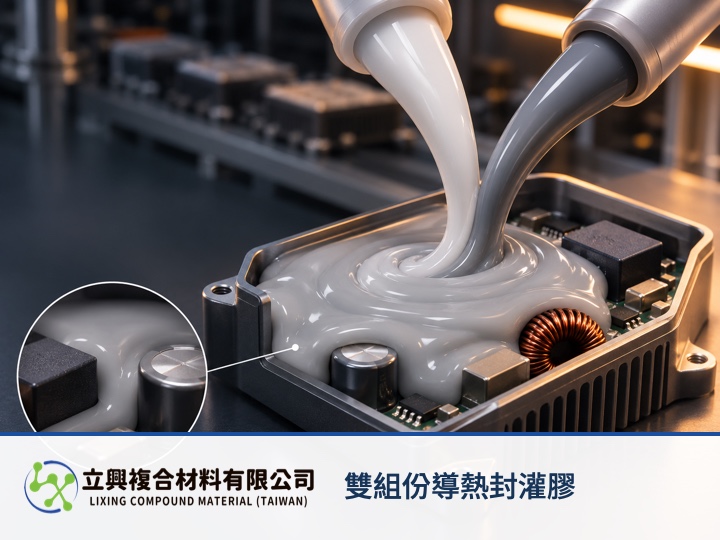
For high-power LED, power-supply, or transformer potting that needs a shorter production cycle, H-GF-GY thermal conductive silicone encapsulant can be cured for about 20 minutes at 80°C. When the assembly should not be heated and the schedule can absorb the wait, the product page lists about 8 hours at 25°C. Both routes begin with the same checks: a 1:1 mix by weight, a 40–60 minute working time at 25°C, and confidence that the potted assembly can reach a controlled temperature. Its self-adhesive processing feature supports electronic applications that need heat transfer, insulation, and protection.
Let assembly temperature and production takt choose the route
Heated curing reduces work-in-process waiting. The product page recommends 80°C for about 20 minutes in winter or fast production cycles. The room-temperature route is about 480 minutes at 25°C and can suit sensors, coils, or electronic modules that are difficult to heat as a complete assembly. These catalog conditions do not replace validation of actual part temperature, fill depth, and oven uniformity.
According to the H-GF-GY product conditions, the listed working time after mixing is 40–60 minutes at 25°C. Mixing, degassing, dispensing, and fixture transfer all consume that window. The product page also notes that a warmer environment shortens the available working period.
Check three product conditions with the cure schedule
Thermal path
The listed thermal-conductivity grades are 1.0 or 3.0 W/m·K under ISO 22007-2. This identifies a material grade; it does not determine total module thermal resistance on its own. Fill depth, contact surfaces, and trapped air affect the assembled heat path. The official instructions recommend vacuum degassing before pouring when higher thermal performance is required.
Electrical insulation
The listed dielectric strength is 10 kV/mm under ASTM D149. Power and transformer designs still require review of working voltage, creepage distance, potting thickness, and structural safety factors. A material specimen value is not a finished-equipment guarantee.
Flame rating and rework
The product page lists UL 94 V-0 and states that cured material can be pried open for component repair. Procurement and process teams can place flame rating, rework needs, and cure takt in one selection table instead of comparing thermal conductivity alone.
Why higher temperature accelerates cure
The Arrhenius equation is k = A × exp(-Ea/(R × T)). Here, k is the reaction rate constant, A is the pre-exponential factor, Ea is activation energy, R is 8.314 J/(mol·K), and T is absolute temperature. IUPAC defines this model for the temperature dependence of a rate constant. For the same formulation and mixing state, when one apparent activation energy is a reasonable description, raising T generally increases k.
This equation explains the principle only. It does not provide H-GF-GY values for Ea or A, and two catalog cure points cannot establish a complete kinetic model. Production release still needs checks of core temperature, surface condition, and actual cure state.
Include mixing and degassing in the takt calculation
Part A and Part B should be stirred separately before they are mixed at a 1:1 weight ratio, within a 3% error margin. Vacuum degassing can reduce the risk of trapped air when higher thermal performance is needed. These operations use part of the working-time window, so a pilot run should record batch size, mixing time, dispensing start, and oven entry.
Information to provide for sampling
- Assembly materials, fill depth, volume per part, and allowable temperature.
- Target takt and whether 80°C heating affects nearby components.
- Thermal-conductivity, dielectric-strength, and flame-rating requirements under comparable test conditions.
- Degassing, rework, and post-cure acceptance requirements.
Review the Thermal Conductive Silicone Encapsulant product page for catalog conditions. Teams planning potting for high-power LED lamps, power supplies, transformers, sensors, or coils should provide assembly temperature limits, fill depth, and takt before selecting the 80°C accelerated route or room-temperature cure. High thermal efficiency and stability depend on controlled mixing and a verified cure process.