
Choosing FFKM, FKM, or Silicone O-Rings: Screen Temperature and Media First
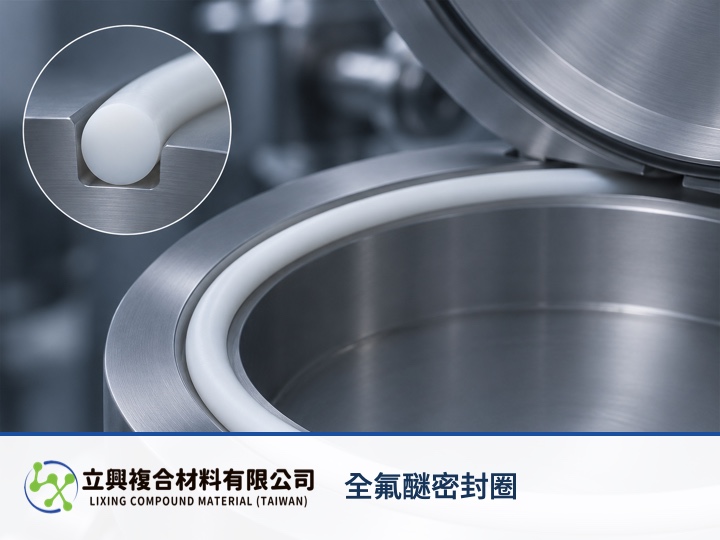
When semiconductor thermal equipment combines high vacuum, heat, and aggressive media, screen materials by operating temperature and chemical compatibility first. Engineers searching for “ffkm oring” sealing options can place the perfluoroelastomer O-ring on the candidate list when high-temperature capability and broad chemical resistance are required. Lixing lists long-term operation up to 320°C and chemical resistance approaching PTFE, so engineers can focus the next comparison on the exact compound, groove, and squeeze conditions.
Use temperature and media to choose the material family
FFKM, FKM, and silicone serve different operating envelopes. FFKM is a strong candidate when high temperature and aggressive chemicals occur together. FKM fits many oil, fuel, and general chemical duties. Silicone is often considered where low-temperature flexibility or dry hot-air resistance matters. A polymer family only narrows the field; concentration, temperature, and compound-specific compatibility still require confirmation.
A 320°C limit creates room for thermal-process screening
When a seal runs near its material limit in a hot vacuum chamber or chemical reactor, elastic recovery and compression set need direct verification. The Lixing FFKM O-ring page lists long-term operation up to 320°C, making it relevant to early screening for semiconductor thermal processes and demanding chemical seals.
Compression set adds a second comparison point
A seal must retain recovery after extended compression to support contact pressure. The product page reports 20% compression set after 70 hours at 300°C, with 75 Shore A hardness and 17.77 MPa tensile strength. These values belong to the stated product and conditions; they do not transfer automatically to a different medium, groove, or dynamic seal.
Structure equal-condition comparisons with Arrhenius
NIST expresses temperature acceleration with the engineering model t_f = A × exp(ΔH / (k × T)). Here t_f is time to failure, A is a scale constant, ΔH is activation energy, k is Boltzmann's constant at 8.617 × 10^-5 eV/K, and T is absolute temperature. The Arrhenius model applies only while the dominant failure mechanism remains unchanged and activation energy is known or fitted. It cannot replace fluid compatibility, pressure, groove, or squeeze testing.
Bring the full duty profile to sampling
Provide continuous and peak temperature, medium and concentration, pressure, static or dynamic motion, groove dimensions, and target squeeze. Those inputs help determine whether FFKM, FKM, or silicone should enter the next validation round instead of selecting by polymer name alone.
Narrow the right candidates for hot chemical sealing
For semiconductor process equipment and chemical fluid systems facing heat, vacuum, and aggressive media, Lixing's 320°C operating statement and PTFE-like chemical resistance provide a clear first screen. Review the official product data, submit the duty profile, and validate the exact compound under the intended conditions.