
Choosing a Heat Conductive Silicone Cap: Compare Caps, Pads, and Sleeves by Contact Path
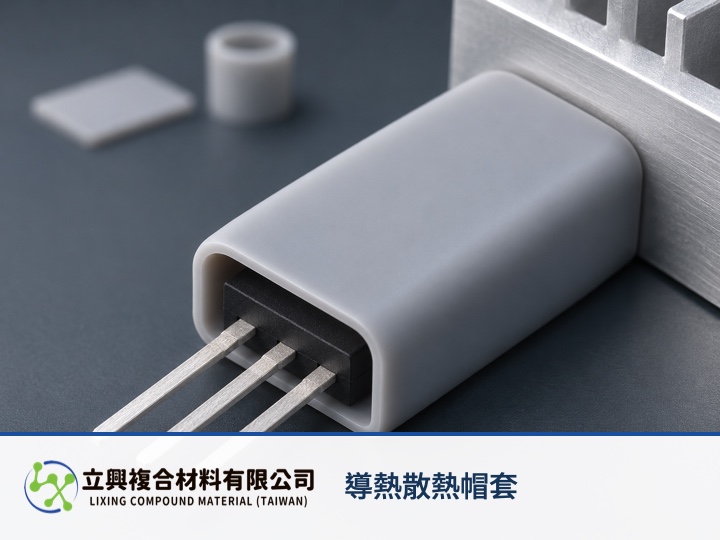
A heat conductive silicone cap covers a TO-220 device body when an assembly needs heat transfer and electrical insulation. Lixing's gray caps serve diodes, transistors, sensing components, and electrical parts. The page lists 0.8-1.0 W/m·K and several TO-220 and TP-3P formats. Compare coverage, contact area, package dimensions, and heat-sink location before choosing a cap, pad, or sleeve.
A cap covers the package body
The heat conductive silicone cap has one closed end and one open end. It follows the component body and sets a clear coverage boundary. The page lists TO-220A/B/C and TP-3PA/B. Sampling starts with package length, width, height, and opening direction.
A pad serves a planar thermal interface
A pad sits between pressable surfaces, so area, thickness, and pressure guide its use. A cap follows the package outline. A pad may suit a device back that meets a heat sink, while a cap covers the body for insulation and protection. This geometry comparison does not guarantee a lower temperature for either form.
A sleeve serves a long section, while a cap serves the package
A sleeve has a long passage for leads or slender sensing parts. A cap has a short rectangular cavity for TO-220 and TP-3P bodies. Both may provide silicone insulation and protection, but their paths differ. Standard cap sizes simplify the first fit check; nonstandard packages still require dimensions and physical conditions.
Use Fourier's law to frame the heat-flow path
A NIST paper gives Q = -kA(dT/dx). Q is heat-flow rate in W, k is conductivity in W/(m·K), A is area normal to heat flow in m², and dT/dx is the temperature gradient in K/m. A cap, pad, or sleeve comparison must consider area and path as well as k. The NIST paper also addresses interface conditions.
Use the relation only for an approximately steady, one-dimensional, uniform path. It omits air gaps, interface resistance, compression, and three-dimensional spreading. The 0.8-1.0 W/m·K value cannot guarantee a device temperature drop or lifetime. A loose cap still requires assembly testing.
Provide four inputs for sampling
- Package designation and body length, width, and height
- Opening direction, required coverage, and keep-clear areas
- Contact surface and mounting pressure between device and heat sink
- Operating temperature, voltage requirement, and system validation method
The page lists -40 to +180°C, voltage resistance above 4 kV, and Shore A 70±5. These are product conditions, not results for every assembly. Engineers working with diodes, transistors, or sensing components can review the standard cap forms and request samples with package, thermal-path, and insulation details.
#SiliconeCap #TO220 #PowerElectronics #ThermalManagement #ElectricalInsulation