
Thermal Grease That Resists Dry-Out and Pump-Out
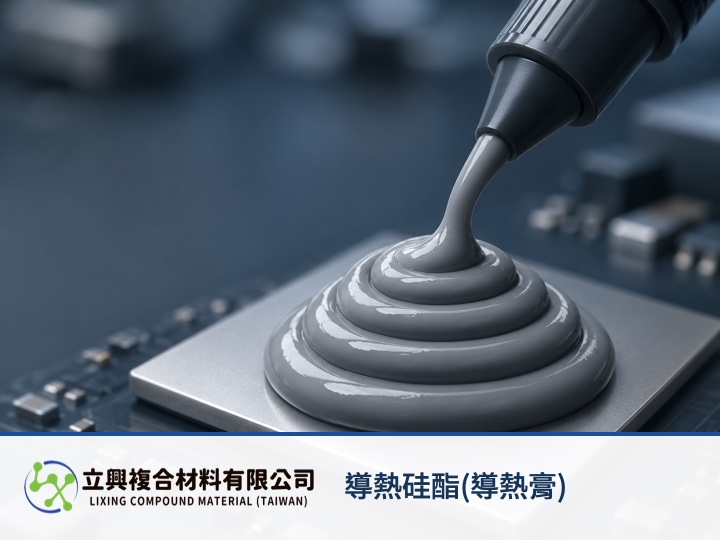
Lixing silicone thermal grease combines high viscosity, non-flowing behavior, and low evaporation to help maintain contact at CPU, GPU, and high-power server-chip interfaces. When temperatures rise after cycling, engineers can inspect the layer for dry-out and migration from the contact zone, then compare ASTM D5470 results only at matched pressure, thickness, temperature, and resistance conditions.
Low evaporation supports a persistent interface
Dry-out reduces a paste's ability to wet and fill microscopic surface irregularities. The product page reports evaporation below 0.001 g and describes the grey paste as high-viscosity and non-flowing. These verified properties are useful screening conditions for prolonged hot contact, but the catalogue figure and its test method do not establish service life in a specific assembly.
High viscosity helps resist cyclic displacement
Chip packages and heat sinks expand by different amounts. Repeated heating and cooling therefore creates relative movement across the interface. If grease migrates away from the contact zone, effective area can shrink and local voids can grow. The product page identifies this grease as non-flowing and suitable between power devices and heat sinks. Pump-out resistance still requires testing with the intended clamp load, surface flatness, and thermal cycle.
2-10 W/m·K grades serve different heat loads
This grey silicone-based thermal grease is available in 2-10 W/m·K conductivity grades and has a stated operating range of -40°C to 250°C. Grade selection should start from heat flux, allowable temperature rise, and the assembled bond-line thickness. A catalogue k value alone cannot describe the complete interface. Power-module buyers and thermal engineers should compare samples in the same fixture and boundary conditions.
Use thermal resistance to frame dry-out and pump-out
One-dimensional steady conduction can be written as R_th = L / (k × A). R_th is layer resistance in K/W, L is effective interface thickness in m, k is thermal conductivity in W/(m·K), and A is effective contact area in m². The flat-wall conduction model in the MIT heat-transfer notes shows why a thicker layer or smaller effective area raises idealized resistance. Voids from dry-out and lost coverage from pump-out both work against the heat path.
The model assumes a homogeneous, steady, one-dimensional layer. It excludes boundary contact resistance, uneven application, aging, and dynamic displacement. ASTM D5470 addresses thermal transmission measurements for thermally conductive electrical-insulation materials. A report should still identify pressure, specimen thickness, temperature, and the resistance definition before its k value is used for material selection.
Keep four conditions in sample validation
- Record the applied amount and assembled bond-line thickness so thickness variation does not mask material differences.
- Hold contact area, clamp load, and surface preparation constant when comparing initial and post-cycle resistance.
- Inspect the contact zone after disassembly for cracking, voids, or a migration boundary outside the original footprint.
- Separate test temperature from the device's continuous operating condition; a momentary temperature rating is a different boundary.
Qualify conductivity and interface stability together
CPU, GPU, and power-module cooling depends on a contact path that remains useful after thermal cycling. Lixing thermal grease offers verified 2-10 W/m·K grades, high viscosity, and low evaporation. For sample consultation, provide device dimensions, heat-sink material, target bond-line thickness, clamp method, and operating temperature so the grade and validation plan reflect the real assembly.
#ThermalGrease #ThermalInterfaceMaterial #ASTMD5470 #CPUCooling #PowerElectronics