
How to Read Electrical Isolation Data for Silicone Foam Enclosure Seals
For outdoor power-distribution and telecom enclosures that need sealing, cushioning, and thermal insulation, the Silicone Foam / Sponge Strip & Tube Series brings uniform foaming, resilience, and electrical data into one material review. The product page lists a typical breakdown voltage above 3000 VAC, but engineers and buyers should align specimen thickness, electrode configuration, and environmental conditions before applying that figure to an enclosure design.
Resilience supports repeated sealing contact
Door frames and enclosure joints repeatedly open and close, so the seal needs to recover its shape to maintain contact. The product page describes high resilience, compression resistance, and uniform foam density for sealing and cushioning in electronics and electrical equipment. Required compression and long-term deformation still need confirmation with the selected dimensions and samples.
Breakdown voltage needs a thickness context
The product page lists a typical breakdown voltage above 3000 VAC. Engineers can use E_bd = V_bd / d, where E_bd is dielectric breakdown strength, V_bd is breakdown voltage, and d is specimen thickness along the electric field. Lehigh University teaching material on dielectric strength likewise relates breakdown voltage to thickness. This model supports comparisons under approximately uniform fields and consistent test configurations. Electrode geometry, voids, temperature, humidity, voltage ramp, and specimen geometry still affect the result, so the typical value is not a guarantee at arbitrary thickness.
Temperature and flame-rating data inform harsh-environment selection
The product page lists a temperature range from -100°C to +300°C and a UL 94V-0 flame rating, while also describing odorless, aging-resistant, and acid/alkali-resistant characteristics. These points can support initial screening for outdoor distribution boxes, telecom enclosures, and industrial equipment. Final design review should confirm the contacting media, operating temperature, flame-rating documentation, and finished-part specification.
Tube and profile forms fit different joints
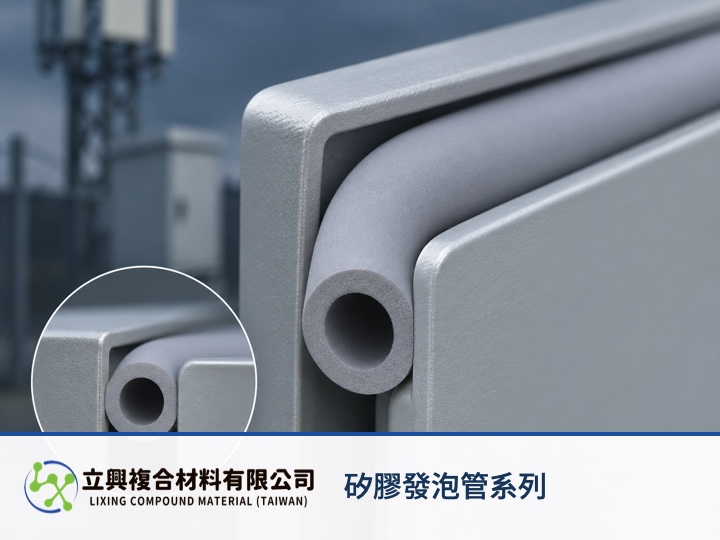
Official product images show round foam tubes and shaped foam profiles with visible openings and matte surfaces. Use the Lixing product page to discuss profile, dimensional tolerance, color, and delivery form, then confirm fit with a sample in the actual joint.
Combine electrical and sealing inputs before sampling
- Provide joint dimensions, target compression, and installation form.
- State operating voltage, temperature, humidity, and contamination conditions.
- Request electrical data with matching thickness, electrodes, and method.
- Confirm temperature, flame-rating, and chemical-contact requirements.
High resilience and uniform foaming make this series relevant to sealing, cushioning, and thermal insulation in outdoor distribution and telecom enclosures. Sharing breakdown-voltage context, thickness, and environmental conditions with Lixing Composite Materials Co., Ltd. gives the specification discussion and sample request a clearer technical basis.