
Custom Shaped Silicone Tube Weathering: Four Conditions to Specify
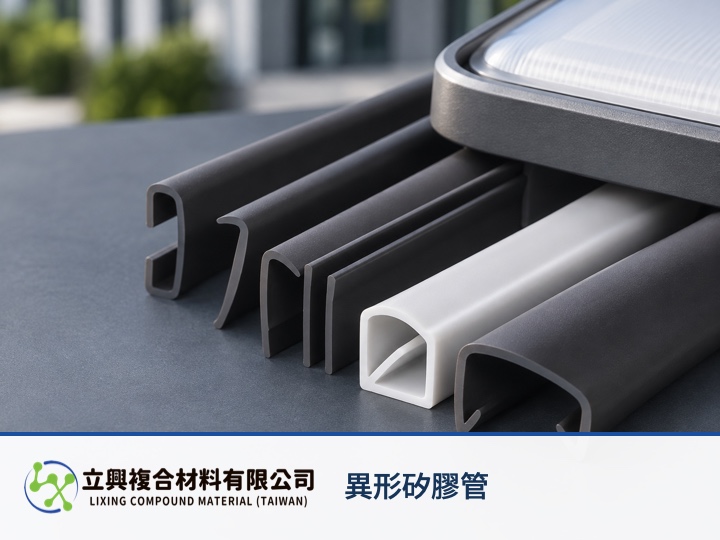
For a custom shaped silicone tube used in outdoor lighting, enclosures or appliance door seals, put light exposure, temperature and humidity, profile fit and validation conditions on the drawing. Lixing lists aging resistance, non-yellowing behavior and a typical -45°C to 200°C range, while offering open and hollow custom profiles. The actual formulation and sample conditions still require confirmation.
Weathering requirements belong in the specification
Non-yellowing behavior is a published feature of this custom shaped silicone tube. It can support visible seals where appearance and profile contact both matter. State whether the part is indoors or outdoors, whether sunlight is direct, the required color and the color-change acceptance method. The page lists white, grey, yellow, black and blue as customizable colors; confirm the final color on samples.
Separate the catalog temperature range from service life
The product page lists -45°C to 200°C as the temperature range. This is an initial material-selection boundary, not an outdoor lifetime promise. For repeated day-night cycling, also define compression, bend radius, joints and continuous strain. The related article on drawing dimensions across temperature explains which dimensions need attention.
Use the Arrhenius equation only for a temperature trend
The Arrhenius rate equation k = A exp(-Ea/(R T)) describes how temperature affects a reaction or degradation rate constant. Here k is the rate constant, A the pre-exponential factor, Ea activation energy, R 8.314 J/(mol·K), and T absolute temperature. The IUPAC definition provides the theoretical basis. A single relation is unsuitable when UV, humidity, contaminants, stress or formulation changes alter the dominant mechanism, so it cannot establish a guaranteed life for this product.
Hydrolytic stability and flexibility support routed seals
The official page also lists hydrolytic stability, softness and free bending. These properties support sealing and protection in electronics, appliances and kitchenware, but contact pressure after bending still depends on profile, hardness and assembly gap. See the article on keeping a custom profile effective around bends for the routing decision.
Send four inputs before sampling
Provide the cross-section and critical dimensions, operating temperature and humidity, light exposure and color acceptance. The page lists typical ranges of 30–80 Shore A hardness, 4–10 MPa tensile strength, 200%–500% elongation at break and 16–50 N/mm tear strength. Do not treat these ranges as delivery values for every formulation. Review the custom shaped silicone tube product page, then validate assembly and weathering with a representative profile sample.
Conclusion
Custom profile geometry, non-yellowing weathering features and a broad catalog temperature range can be considered in one seal design. Defining light, heat, moisture and profile conditions before selecting color, hardness, curing method and validation makes the sample request more representative of service.