
G-TT-GY Fiberglass-Reinforced Thermal Silicone Tube for Predictable Radial Heat Flow
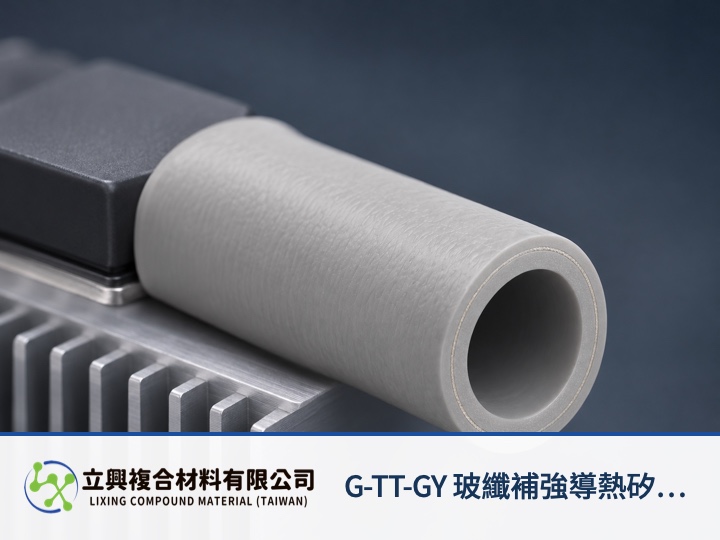
G-TT-GY fiberglass-reinforced thermal conductive silicone tubing combines an insulating, cushioning and heat-transfer interface around a power device, giving engineers a cylindrical geometry for evaluating radial heat flow. Start with device shape, tube inner and outer diameters, the available 5–10 mm wall-thickness range and actual contact surfaces, then use samples to verify assembly resistance rather than relying on thermal conductivity alone.
A conformable wall supports a continuous heat path
The soft, compressible wall can conform to the gap between a component and heat sink, helping avoid obvious unsupported regions. The G-TT-GY product page lists thermal conductivity of 1.5 ± 0.3 W/m·K. This is a material value; interface condition, mounting pressure and dimensional fit still affect an assembly.
One annular fiberglass layer supports tube-wall geometry
A single ring-shaped fiberglass-cloth reinforcement layer is embedded at the center of the silicone wall to support dimensional stability and pressure resistance during sleeving and compression. It is not a stack of multiple fiberglass layers. Inner diameter, outer diameter and wall thickness still require confirmation against the device profile and sample.
Heat transfer and electrical insulation share one sleeve location
The official page identifies power transistors, MOSFETs, ICs and power modules as applications and lists electrical insulation, UL 94 V-0 and an operating-temperature range of -40 to 200°C. These typical values support initial screening; final design depends on dimensions, electrical conditions and the confirmed custom specification.
Cylindrical-wall conduction relates radius to heat flow
Steady radial conduction can be expressed as Q = 2πLk(T1 - T2) / ln(r2/r1). Q is heat-transfer rate in W, L is effective length in m, k is thermal conductivity in W/(m·K), T1 and T2 are surface temperatures, and r1 and r2 are inner and outer radii in m. Colorado State University's heat-transfer reference explains why cylindrical area changes with radius. The model assumes a homogeneous wall, approximately constant k and steady radial flow. It excludes contact resistance at both interfaces and is not measured temperature-drop data for this product.
Sample verification returns the model to the assembly
For a sample request, provide the device profile, target inner and outer diameters, wall thickness, effective sleeving length, operating temperature and insulation conditions. Use the official product page to contact Lixing for specifications and samples, keeping the engineering model separate from a finished-assembly guarantee.