
Match a Gold Silicone Buffer Pad to CCL and PCB Lamination Inputs
A Gold Silicone Buffer Pad lets CCL and PCB lamination teams document insulation and cushioning requirements in one selection record. Start with press force and loaded area, then specify pad dimensions, twill or plain weave, temperature conditions and tolerances before arranging a sample trial.
Convert total force into a comparable pressure input
Press force only becomes useful for comparison when the loaded area is known. Average normal stress is expressed as σ = F / A, where σ is average normal stress in Pa, F is perpendicular force in N and A is loaded area in m². The equation and its engineering context are described by OpenStax Physics.
This equation converts total force into an idealized average pressure for comparing plate area, pad size and setup conditions. It does not describe local warpage, edge effects, surface texture, thickness tolerance or viscoelastic behavior. The calculated value is therefore a planning input, not a product guarantee or a replacement for press validation.
A composite pad combines insulation and cushioning roles
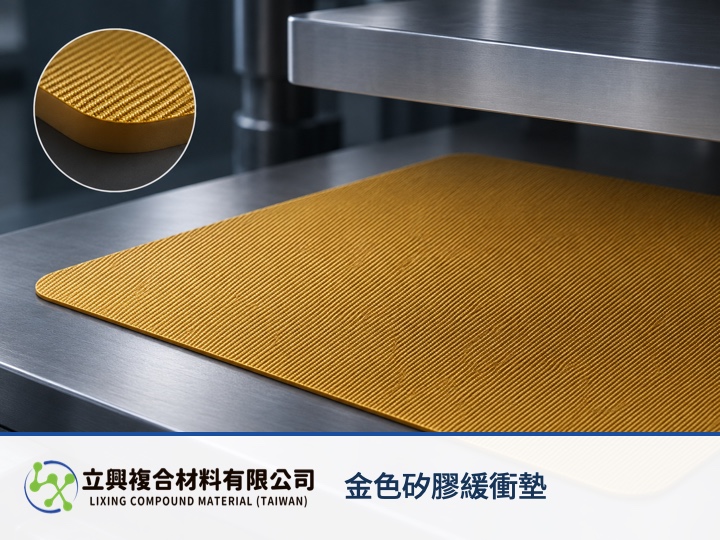
The official product page states that LX-GB260 combines glass fiber and fluorine rubber for press-plate insulation and cushioning in PCB and CCL lamination. The pad is golden yellow, with a fine visible texture and rounded rectangular outline in the official photographs. These verified facts come from the Gold Silicone Buffer Pad product page; no unpublished internal layer count is inferred.
Twill and plain weave provide two surface choices
The product is offered with twill and plain-weave surfaces. The official page describes the twill texture as deeper and the plain texture as shallower while keeping the material and listed specifications the same. Record the plate surface, stack contact arrangement and preferred pattern so that both choices can be assessed within the same trial plan.
Keep tolerances and temperature data beside the press setup
The catalog lists heat resistance up to 260 °C, cushioning above 12% and tensile strength of at least 25 MPa. It also lists thickness tolerance at the nominal value ±0.3 mm and length/width tolerance at +2/-1 mm. Thermal shrinkage is listed as 0 under the stated 240 °C for 120 minutes condition, with 500 cycles listed. Each value belongs to its stated context, so provide target dimensions, temperature profile, plate area and use pattern together rather than projecting one number across every process.
Prepare four inputs before requesting a sample
Provide the effective plate area and force, target pad length, width and thickness, twill or plain-weave preference, and the actual temperature profile and cycle pattern. Review the product specifications and photographs before requesting a sample. Lixing Composite Materials Co., Ltd. operates its factory at Building 1, No. 5, Dong'ao Industrial Zone, Qianwu Town, Zhuhai, Guangdong, China. The website does not offer online checkout; contact yw@zh-lx.com or LINE/WeChat jerryhuang for samples and specification support.