
Die-Cut Antistatic Silicone Pad: Turn 3.0 mm Sheet into Custom Gaskets
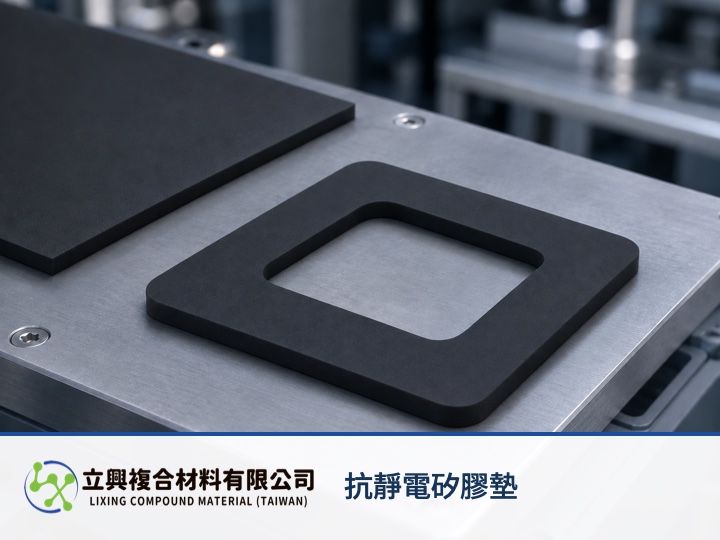
When a fixture or equipment interface needs an antistatic path, soft contact, and a custom outline, an antistatic silicone pad can be cut from 3.0 mm sheet into pads, liners, or gaskets. The search phrase “black ESD protection conductive silicone sheet” describes that material need; the drawing still has to define the actual cut part. Define the outer profile, inner perimeter, dimensional tolerances, and contact location first, then sample with the intended material and tooling. That sequence gives electronics fixtures, equipment cushions, and protective liners a drawing that can be inspected before production.
Cut the contact profile instead of carrying excess sheet
The official product page states that the 3.0 mm sheet is suitable for cutting into pads, liners, and gaskets. A drawing can therefore follow the actual contact area. Place the outer profile, holes, edge distances, and orientation datum on one drawing so the cutting trial corresponds to the fixture or equipment interface rather than to a simple length-and-width request.
30 Shore A supports soft contact and cushioning
The reviewed hardness is 30 Shore A, and the product page describes low hardness and conformability for cushioning contact. This makes the black sheet relevant where a soft gasket must follow a component or fixture surface. Compression, recovery, and assembly tolerance still require sample validation; hardness alone does not establish a target compression ratio.
50 ± 10 Ω belongs on the same drawing review as contact location
The catalog-approved resistance is 50 ± 10 Ω. Published applications include precision electronics assembly pads, PCB production-fixture consumables, and cushioning for semiconductor equipment. During sampling, review the intended contact location, conductive continuity, and grounding path together. The resistance value does not by itself establish discharge time or the ESD rating of a complete system.
Cut perimeter is an early indicator of required shearing force
A first-order flat-tool relationship is P = A × t × τ ÷ 1000. P is estimated shearing force in kN, A is total cut-contour perimeter in mm, t is material thickness in mm, and τ is material shear stress in N/mm². AMADA’s punching-force explanation presents this equation for sheet metal. For silicone die cutting, use it only as a comparative relationship for perimeter and thickness. Tool sharpness, clearance, speed, lubrication, elastic recovery, and material variation affect the actual result.
Start the quotation with a sample-ready drawing
Provide the finished outline, holes, edge distances, quantity, working face, and assembly orientation, then state the contact location and electrical acceptance method. After reviewing the antistatic silicone pad specifications, contact Lixing for samples or specification consultation. Production release should follow a cutting trial with the intended tool, material, and inspection conditions.