
Thermal Silicone Encapsulant Conforms Around Uneven Power-Module Components
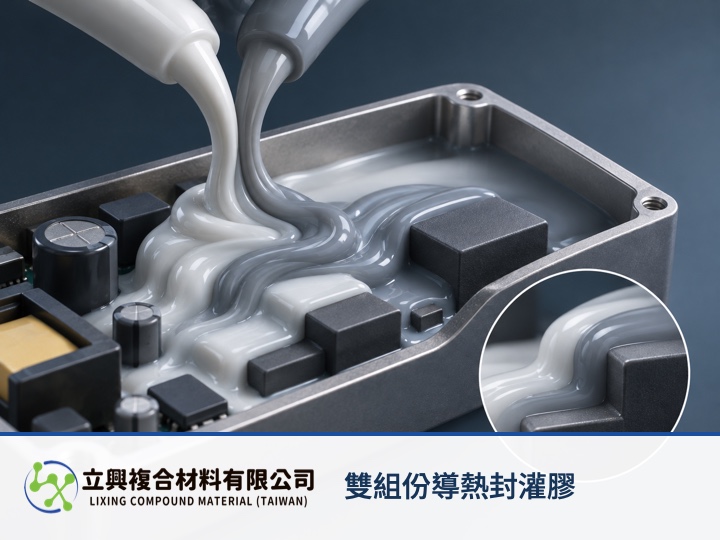
Power modules rarely present one flat surface. When a potting material follows component contours and fills the surrounding volume, the contact path from heat sources toward the metal enclosure can become more continuous. Official H-GF-GY information describes a flexible, elastic two-part thermal silicone encapsulant that covers uneven surfaces, with 1.0 and 3.0 W/m·K options. This article focuses on that conformability benefit while keeping module-level performance subject to sampling and measurement.
Flow around component contours reduces uncontrolled void regions
The practical benefit starts before cure: mixed material can enter the spaces around components and then retain flexibility after cure. The H-GF-GY thermal silicone encapsulant product page identifies Part A as a white fluid and Part B as a gray fluid, mixed 1:1 by weight. It also states that flexibility and elasticity allow the material to cover uneven surfaces. This makes the product relevant to power supplies, transformers, sensors, and other assemblies with varied component heights.
Three benefits turn conformity into a testable thermal path
Conform around height changes and reach more of the available surface
Flowing around component and enclosure contours can reduce large unsupported regions. The source supports uneven-surface coverage, but it does not publish a void fraction for a particular module. A sample build still needs sectioning, imaging, or temperature measurements to confirm filling quality.
Choose 1.0 or 3.0 W/m·K as part of the heat-load evaluation
The product page lists thermal conductivity options of 1.0 and 3.0 W/m·K under ISO 22007-2. Material conductivity is not the assembled thermal resistance. Potting thickness, contact area, housing material, and heat-source position remain part of the design calculation.
Fit curing to the available equipment and process window
Published curing conditions are approximately 20 minutes at 80°C or 480 minutes at 25°C. The working time is 40–60 minutes at 25°C. A production team can compare heated and room-temperature curing, while pilot runs establish the real mixing and dispensing window because higher ambient temperature shortens working time.
Thermal contact conductance explains what the interface measurement means
h_c = Q / (A × ΔT_c)
- h_c: interface thermal contact conductance, W/(m²·K)
- Q: steady heat-flow rate through the interface, W
- A: apparent contact area, m²
- ΔT_c: temperature drop across the interface, K
For the same heat-flow rate and apparent area, a smaller interface temperature drop corresponds to higher contact conductance. The relation is documented in NASA's Thermal Contact Conductance in a Vacuum Environment. It applies to steady conditions where area and interface temperatures can be defined. It is an engineering framework, not an H-GF-GY specification: surface topography, voids, dispensing, and cure quality still affect the measured result.
Balance dielectric protection, heat transfer, and rework in a sample module
The product page lists 10 kV/mm dielectric strength, 1 × 10^13 Ω·cm volume resistivity, and UL 94 V-0, and notes that cured material can be pried open for component repair. These are published material properties. The finished module still requires validation at its actual spacing, thickness, and operating environment. For a related view of interface behavior, read the existing thermal encapsulant contact-resistance article.
Send component height, heat-source, and enclosure details with a sample request
Useful sampling inputs include the highest and lowest component positions, target potting depth, enclosure material, heat-source map, curing equipment, and rework requirement. Review the official H-GF-GY product data, then contact yw@zh-lx.com for a sample or specification consultation.
#ThermalEncapsulant #ElectronicsPotting #ThermalManagement #PowerModule #Silicone