
Heat Dissipation Tube Encapsulation Aligns Insulation and Heat Flow Around Power Components
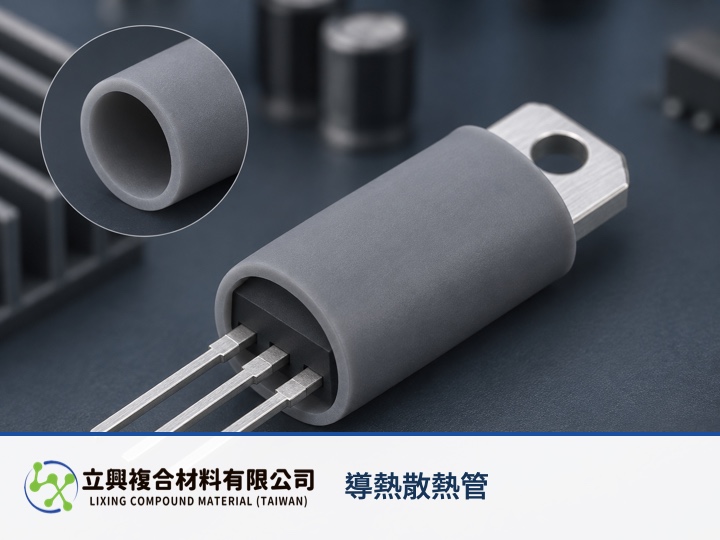
A heat dissipation tube places component sleeving, electrical insulation, and a radial heat-flow path in one grey silicone part. For diodes, transistors, and sensing components, engineers can specify the inner diameter, effective sleeve length, and real contact condition together, making the encapsulation boundary easier to inspect and validate.
A fitted sleeve manages the component outline
A cut section of tube can fit directly over the component body, avoiding a separate stack of sheet materials. The Heat Dissipation Tube product page lists encapsulation and thermal protection for diodes, transistors, electronic sensing components, and precision electrical devices. Its listed inner-diameter range is 0.5 to 25 mm; the final fit still depends on the component outline and tolerance.
Dielectric strength above 4 kV supports the insulation decision
The product page lists dielectric strength above 4 kV, giving engineers a documented input for the sleeve selection. This material value under stated test conditions does not replace system creepage distance, exposed ends, or assembly-level withstand-voltage verification. End allowance and post-assembly inspection remain design-specific.
Temperature and flame classifications suit power-component surroundings
The listed working-temperature range is -30 to +210°C, with a UL 94 V-0 flame rating. These are relevant inputs where a sleeve must address both the thermal environment and a material flame classification. Hot spots, airflow, and adjacent materials can change the finished assembly result, so sample and assembly verification remain necessary.
Cylindrical resistance shows how the tube wall carries heat
Steady radial conduction through a cylindrical wall can be represented by R_cond = ln(r2/r1) / (2πkL), with Q = ΔT / R_cond. R_cond is conduction resistance in K/W; r1 and r2 are inner and outer radii in m; k is thermal conductivity in W/(m·K); L is effective sleeve length in m; and ΔT is the surface-temperature difference in K. Colorado State University’s heat-transfer reference presents this model. It assumes steady one-dimensional radial conduction and an approximately uniform material. It excludes contact gaps, end effects, and convection, so it cannot predict the product’s installed temperature or service life by itself.
Share the geometry and boundary conditions when requesting samples
Useful inputs include the component outline, required inner diameter, sleeve length, working temperature, dielectric requirement, and assembly method. Lixing Composite Materials Co., Ltd. can discuss size, colour, and physical-property options. Review the tube specifications and applications, then use samples to confirm fit, exposed ends, and the actual thermal boundary.
#HeatDissipationTube #SiliconeTube #PowerElectronics #ThermalManagement #ElectricalInsulation