
G-TT-GY Fiberglass-Reinforced Thermal Silicone Tube for Dimensional Stability
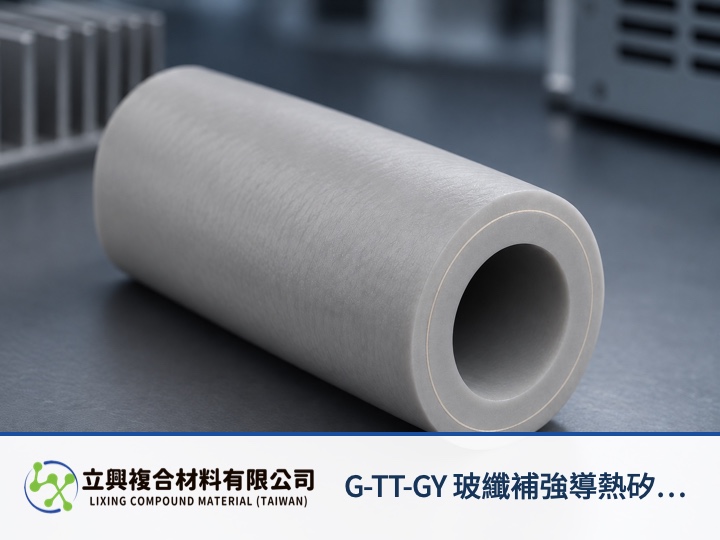
G-TT-GY fiberglass-reinforced thermal conductive silicone tube helps a power-device assembly retain thermal contact, electrical insulation, and tube-wall geometry as temperature changes. Its official product page identifies one annular fiberglass-cloth reinforcement layer in the center of the wall, a useful construction for MOS devices, ICs, and power modules where fit must remain controlled. Selection still depends on actual bore, outer diameter, wall thickness, compression, and temperature excursion.
Annular reinforcement supports the tube geometry
G-TT-GY fiberglass-reinforced thermal silicone tube uses a silicone-rubber matrix with one continuous fiberglass-cloth ring embedded at the center of the wall. The product page associates this construction with dimensional stability and pressure resistance. Actual reinforcement performance must still be verified for the specified diameter, wall thickness, and loading mode; the construction alone does not establish service life.
Thermal transfer and insulation share one sleeve
The product page lists thermal conductivity of 1.5 ± 0.3 W/m·K, volume resistivity of 10^12 Ω·cm, breakdown voltage of at least 3 kV, and UL 94 V-0. These are catalog typical values that let engineers review the heat path and insulation requirement together. Finished-assembly performance also depends on dimensions, contact, compression, and test conditions.
A compliant wall follows the power-device profile
The listed wall-thickness range is 5–10 mm and hardness is 30–70 Shore 00. The official page also describes the material as soft, compressible, and slightly tacky. When reviewing the formal G-TT-GY specifications, provide the component profile, heat-sink clearance, and assembly pressure rather than selecting from conductivity alone.
Use linear expansion to frame dimensional allowance
The linear approximation is ΔL = α L0 ΔT, where ΔL is length change, α is the coefficient of linear thermal expansion, L0 is initial length, and ΔT is temperature change. A NIST dimensional-measurement reference explains how thermal expansion contributes to length uncertainty. The approximation assumes uniform temperature, small strain, and a reasonably constant α over the interval. The product page does not state α for G-TT-GY, so the equation cannot calculate its actual elongation.
Send temperature and geometry together with the sample request
The published operating-temperature range is -40 to 200°C, which does not establish the allowable thermal cycle for every assembly. A useful sample request includes bore and outer diameter, wall thickness, device profile, minimum and maximum operating temperature, compression method, and insulation requirement. The finished assembly should then be checked for dimensional fit and thermal performance.
#ThermalSiliconeTube #FiberglassReinforcement #ThermalManagement #ElectricalInsulation