
Conductive Foam Selection: The Gapped Seams Where One Part Handles Shielding, Grounding and Cushioning
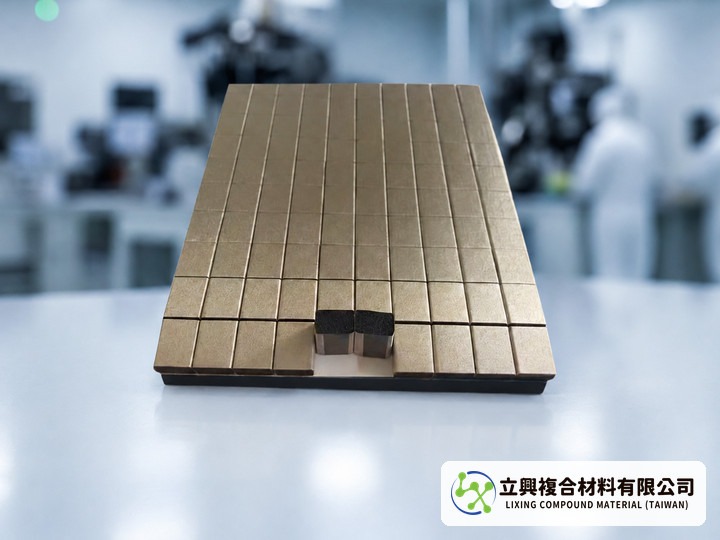
Conductive foam fits seams where two conductive surfaces leave a gap, the joint must carry a ground connection, and the assembly also needs cushioning. The LXD Conductive Foam Series combines conductive fabric, conductive foam and conductive pressure-sensitive adhesive in one part, and its product page lists shielding of ≥ 30 dB from 10 to 1000 MHz. Match that against your interference band, seam length and available compression, then request samples for an in-device check.
Seams between housings, shield cans and the main board are often where shielding leaks first. Stamped and machined parts never sit perfectly flat, and the stretch between two screws may not be pressed tight, so that gap becomes an exit for electromagnetic energy. Conductive foam turns the seam into continuous conductive contact while taking up the height variation.
One part restores contact across a gapped seam
The foam core fills the gap and the fabric carries current, and the pair is what keeps an uneven seam in contact. The product page states that the high-resilience foam base fills mechanical gaps and maintains consistent contact pressure after compression, while the outer conductive fabric provides the current path.
Where both sides of the seam are flat with almost no gap, the Lixing Conductive Cloth Tape Series is worth evaluating instead. Where there is a step or the assembly needs cushioning, conductive foam is the better fit.
Two resistance values for the ground path
Grounding comes down to whether current can pass freely from one metal part to the next. The LXD page lists surface resistance of ≤ 0.1 Ω horizontally and ≤ 0.2 Ω vertically, measured with a resistance tester. Conduction along the fabric and through the thickness both have a published figure, so each can be checked against your ground path.
Adhesive backing keeps the part where you put it
Conductive foam usually sits on the inside of a housing or shield, and once the adhesive lets go the contact is lost. The series uses a conductive pressure-sensitive adhesive with retention power of ≥ 1440 min (SUS304, 1 kg/inch) and tensile strength of ≥ 1.5 N/20mm, which suits assembly positions that must stay bonded over long service.
A shielding figure tied to a frequency band
The ≥ 30 dB shielding effect on the product page applies from 10 MHz to 1000 MHz. If the interference in a phone, laptop or communication unit falls inside that band, the value can be compared directly; outside it the page gives no figure, so measure with samples. Thickness can be customized to the mechanical design, and full parameters are on the Conductive Foam Series product page.
Where it fits
- Phones and laptops: EMI shielding and precise grounding at housing seams and shield covers.
- Communication equipment: seams between module housings and chassis that need conduction and cushioning.
- Automotive electronics: shielding and grounding points inside control-unit housings, confirmed with samples.
- Inside electronic products: component gaps that need cushioning, grounding and EMI shielding together.
Why a seam needs a conductive bridge
Engineering model: S = 20 log10(V_ns / V_sh); f_c = 15000 / l; S_hole ≈ 20 log10(f_c / f). These relations come from Rose-Hulman Institute of Technology EM lecture notes 24. They are engineering approximations that explain the principle, not specifications or guaranteed values for this product.
Variables: S is shielding effectiveness (dB); V_ns and V_sh are the interfering voltages without and with the shield; f_c is the aperture cutoff frequency (MHz); l is the largest linear dimension of the hole or non-contacting seam (cm); f is the interference frequency of interest (MHz); S_hole is the approximate shielding of a single thin hole below cutoff (dB).
Numbers make it concrete. A 30 dB figure means the interfering voltage drops to about 1/31.6. A 15 cm seam with no conductive contact has an f_c of about 1000 MHz, so it gives almost no shielding at 1000 MHz. Shorten the non-contacting stretch to 1.5 cm with a conductive material and f_c rises to about 10000 MHz, giving roughly 20 dB at the same frequency. The notes also call for low surface resistance, adequate contact pressure and seams free of paint and grease, and they point to pliant conductive gaskets for critical seams.
Conditions and limits: the hole formula holds only for f below f_c and covers a single hole in an infinitely thin shield. It ignores thickness attenuation, multiple holes (the notes subtract 10 log10 N), near-field effects, resonances and cable penetrations. The 30 dB product value is a material figure under its own test conditions, not enclosure shielding, which still has to be measured.
What to send with an inquiry
- The interference band you need to control, and whether it sits within 10–1000 MHz.
- Seam length, gap range and available compression space.
- Mating surface material and finish, including any paint or oxide.
- The bonding surface for the adhesive and the assembly method.
For sizing thickness from a gap distribution, see conductive foam thickness for assembly tolerance; for stepped housing seams, see conductive foam for uneven enclosure gaps.
Put the seam on conductive foam
A seam that has a gap, needs a ground and needs cushioning can be handled with one conductive foam part. Request the TDS and samples on the Conductive Foam Series product page, or email yw@zh-lx.com with seam dimensions and the interference band, and Lixing Composite Materials Co., Ltd. will help with specification advice.
#ConductiveFoam #EMIShielding #Grounding #ConductiveMaterials