
Platinum Cured Transparent Silicone Tubing for Fluid Transfer: No Cure By-products, No Bloom
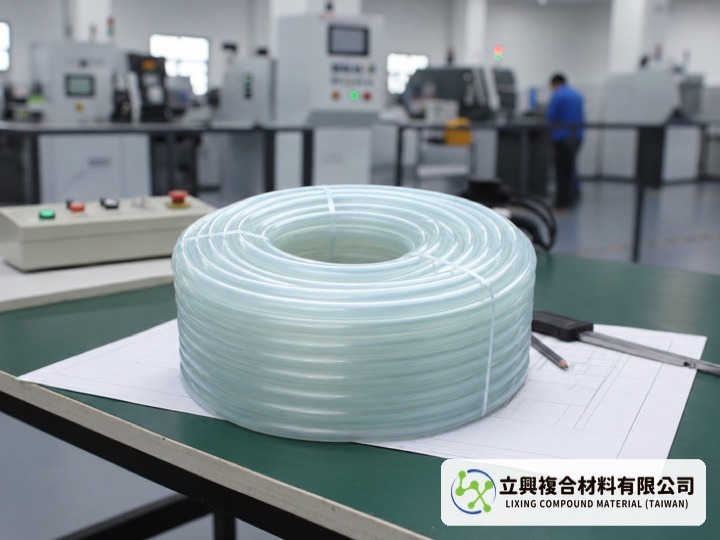
For food, pharmaceutical and laboratory fluid lines, start a transparent silicone tube selection with the cure system: platinum cure crosslinks by an addition reaction that forms no peroxide decomposition by-products, and the Lixing tube contains no phthalate plasticizers and does not bloom in long-term use. The three specs buyers check are temperature range (-50°C to 200°C), hardness (Shore 30A to 80A) and tolerance (±0.05 mm on precision grades), all listed on the Transparent Silicone Tube specification table.
Our October 22 article on kink resistance and bend radius covered routing. This one moves to the material: what the cure leaves in the tube wall, and why that matters more as the bore gets smaller.
Four Benefits of Platinum Cure in a Fluid Line
No cure by-products left in the wall
One class of residue that would need a post-cure to drive off is simply never formed. According to the Gelest technical note on vinyl-functional silicones, platinum-catalyzed addition cure forms no byproducts, while peroxide-cured silicone needs a post-cure at a higher temperature to remove volatile peroxide decomposition products. The Lixing product page states that, compared with traditional peroxide-cured silicone tubes, this tube offers higher transparency, odorless performance and stable physical properties.
No plasticizers, no surface bloom
A white haze on an aged clear tube leaves you guessing whether it is fluid residue or something leaching from the material. The tube is made from imported food-grade pure silicone, free of phthalate plasticizers, and the product page notes it resists surface blooming in long-term use.
A clear wall shows what the fluid is doing
Bubbles, deposits and color shifts can be spotted from outside the tube. The standard tube is odorless, non-toxic and naturally transparent, with custom colors available for line identification, which suits equipment and benches where operators check the flow by eye.
Temperature and hardness ranges that fit the process
One material covers both chilled transfer and hot fluids: the rated range is -50°C to 200°C, and hardness can be chosen between Shore 30A and 80A. Automated extrusion keeps the tube mouth round and the wall thickness uniform. Softer grades suit lines that need easy bending; firmer grades suit lines that need to hold their shape.
Smaller Bore, More Wall per Liter
Engineers comparing options for fluid transfer and platinum cured tubing can weigh material purity with a simple area conversion. Article 17 of Regulation (EU) No 10/2011 expresses migration in mg/kg using the real surface-to-volume ratio in use. Applied to a tube bore:
C_F = m_A × (S / V), S / V = 4 / d_i
- C_F: concentration in the fluid of substances from the tube wall (mg/kg)
- m_A: migration per unit contact area (mg/dm²), obtained only by actual testing
- S: inner wall area in contact with the fluid (dm²)
- V: amount of fluid held in the tube (kg; about 1 L ≈ 1 kg for water-based fluids)
- d_i: tube inner diameter (dm)
The wetted area of a bore is π·d_i·L and its volume π·d_i²·L/4, which gives 4/d_i. At a 6 mm (0.06 dm) inner diameter, each kilogram of water-based fluid touches about 66.7 dm² of wall, roughly 11 times the conventional 6 dm²/kg ratio the regulation applies in certain cases. Halve the bore to 3 mm and the contact area doubles again. The narrower the line, the more the cure system and plasticizer content deserve attention before anything else is specified.
Applicability and limits: the expression fits fluid that stands or dwells in the tube, with concentration estimated from an area-based migration value; under continuous flow, exposure also depends on flow rate and contact time. Regulation (EU) No 10/2011 covers plastics and silicone rubber is outside its direct scope, so only the area-conversion concept is borrowed. m_A must come from testing of the actual grade; no value is given here, and the expression is not a product specification or a compliance decision. Source: Commission Regulation (EU) No 10/2011, Article 17.
Where It Fits
The product page lists food equipment, pharmaceuticals, laboratories and high-end electronic sealing. Food and pharmaceutical lines benefit from the odorless, non-blooming wall; small-bore laboratory lines sit in the high contact-area range shown above; electronic sealing draws on the wide temperature range and soft, elastic recovery. For purity-focused selection in food and pharma lines, see our transparent silicone tube purity selection notes.
What to Send With an RFQ
- Inner and outer diameter, or inner diameter and wall thickness
- Hardness (Shore 30A to 80A) and tolerance class (standard ±0.1 mm, precision ±0.05 mm)
- Operating temperature and the fluid in contact
- Food-contact or medical documents you need, confirmed by our sales team for the specific grade
Send these details with a sample request so you can compare against your current tube; the full specification table and color options are on the Transparent Silicone Tube product page.
Conclusion
The narrower and cleaner the fluid path, the earlier the material conditions should be fixed. Platinum cure, no plasticizers and no bloom take one variable out of food, pharmaceutical and laboratory lines. For specification support or samples, email yw@zh-lx.com or contact Lixing Composite Materials Co., Ltd. through the product page.
#TransparentSiliconeTube #PlatinumCured #SiliconeTubing #FluidTransfer #FoodGradeSilicone