
Phase Change Thermal Pad Contact: Solid at Assembly, Wets the Heat Sink Interface at 45 to 55°C
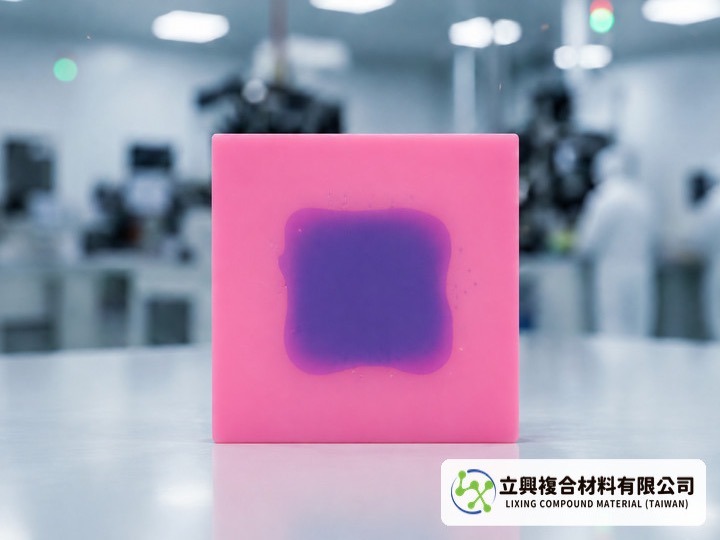
When a heat sink is clamped onto a component, the two metal faces touch only at the tips of their surface asperities and the rest of the joint is air. The LXPCM Phase Change Thermal Pad is a solid pad at room temperature, so it die-cuts and places like any pad; once operation brings the interface to 45°C to 55°C it gradually softens, wets both surfaces and expels the air gaps. Check three specifications in this order before sampling: phase change temperature 45°C to 55°C, thermal impedance 0.08 °C·in²/W, and operating range -40°C to 125°C.
A Pad at Assembly, a Filled Interface in Service
Die-cut and place it like any pad
The line receives a solid sheet that can be die-cut to the component outline and placed by pick-and-place equipment, with no dispense volume or squeeze-out to manage. The product page states that LXPCM is solid at room temperature for easy die-cutting and automated assembly.
At 45°C to 55°C the material fills the gaps itself
The phase change happens after the device starts running, so contact does not depend on forcing the joint into place during assembly. According to the LXPCM product page, the material gradually softens at its 45°C to 55°C phase change temperature, flows into the fine irregularities between the mating surfaces, wets the interface and eliminates air gaps.
A shorter heat path from chip to heat sink
A filled joint leaves heat fewer detours. The published values are a thermal impedance of 0.08 °C·in²/W and a thermal conductivity of 4 W/m·K by ASTM D5470.
No pump-out or dry-out through thermal cycling
Pump-out and dry-out are the usual ways grease joints open voids over time. The product page states that LXPCM does not show these issues compared with conventional thermal grease, operating from -40°C to 125°C without drying, cracking or sagging under long-term thermal cycling.
Why Dry Contact Only Responds to Pressure and Finish
When two metal parts are pressed together dry, heat crosses only where asperities touch. The Cooper, Mikic and Yovanovich plastic contact model gives this correlation:
h_c × σ / (k_s × m) = 1.25 × (P / H_c)^0.95
- h_c: solid-to-solid contact conductance through touching asperities (W/m²·K)
- σ: combined RMS surface roughness of the two surfaces (m)
- m: combined mean asperity slope magnitude (rad)
- k_s: harmonic mean conductivity 2k_A·k_B/(k_A+k_B) (W/m·K)
- P: nominal contact pressure (Pa)
- H_c: contact microhardness of the softer surface (Pa)
The expression is Eq. (1) in Experimental Study on Thermal Contact Conductance of Bead Blasted SS 304 at Light Loads by Milanez, Culham and Yovanovich of the University of Waterloo Microelectronics Heat Transfer Laboratory. Dry conductance depends on the pressure-to-microhardness ratio P/H_c together with roughness and slope, so the only levers for a larger h_c are clamp force and surface finish. Yovanovich's interface conductance course notes treat the joint as solid contact h_s in parallel with the gap medium h_g, and list the gap substance (gas, liquid, grease or solid) among the factors that set contact conductance. A phase change pad works on h_g by replacing the air between asperities with a material that wets both faces.
Applicability and limits: the correlation covers nominally flat metal surfaces with isotropic roughness under plastic asperity deformation, and the source paper reports that it underpredicts measurements at light loads. It excludes conduction through the gap medium, says nothing about the phase change material itself, and needs other models for flatness deviation or waviness. Use it to understand the limits of dry contact, never to predict this product's thermal resistance, required pressure or service life.
Where It Fits
The product page lists high-end electronic components, power modules, automotive electronics and servers, all high heat-load interfaces carrying heat from the chip to the thermal module. Machined heat sink bases and component packages both carry surface texture, and when clamp force is capped by what the component can tolerate, an interface material that fills gaps on its own gives more margin than pressure alone.
Read Catalog Numbers With Their Test Conditions
Conductivity and resistance values are measured at a specific pressure, thickness and method. LXPCM's 4 W/m·K is listed by ASTM D5470, while the product page does not state test pressure or specimen thickness, and the 0.08 °C·in²/W impedance has no listed test condition. For comparing phase change pads on D5470 data, see our earlier guide to D5470 values and interface filling for phase change thermal pads; for gap and compression decisions on conventional pads, see our PCB thermal pad selection article.
Confirm These Before Requesting Samples
- Whether the interface reaches 45°C to 55°C in normal operation; below that range the material stays a solid pad
- The gap between component and heat sink, which sets the custom thickness
- Whether the device's cold and hot extremes fall within -40°C to 125°C
- The pressure and thickness behind any resistance figure you plan to compare
Send these conditions to yw@zh-lx.com, or contact us through the phase change thermal pad product page for samples and specification support. Lixing Composite Materials Co., Ltd. manufactures in Zhuhai, Guangdong, and thickness is customizable.
Sources: Lixing's official product pages (checked 2026-10-28) and the University of Waterloo Microelectronics Heat Transfer Laboratory contact conductance paper and course notes. The formula is an engineering model, not a product specification; this article is an AI draft pending human review.
#PhaseChangeThermalPad #ThermalInterfaceMaterial #ContactResistance #PowerModuleCooling #Lixing