
G-TT-GY Fiberglass-Reinforced Thermal Silicone Tube: Insulate and Cool Power Devices with One Sleeve
When a power MOSFET or power module sits against a heat sink, engineers often have to trade an insulating sheet against a thermal material. The G-TT-GY Fiberglass-Reinforced Thermal Conductive Silicone Tube lets one tube wall handle both jobs: the product page lists 10^12 Ω·cm electrical resistivity, ≥ 3 kV dielectric breakdown voltage and UL 94 V-0, with 1.5 ± 0.3 W/m·K thermal conductivity. Screen with those three data points first, then sample at your real wall thickness and working voltage to confirm the fit for your power device.
One sleeve puts insulation and heat transfer in the same interface
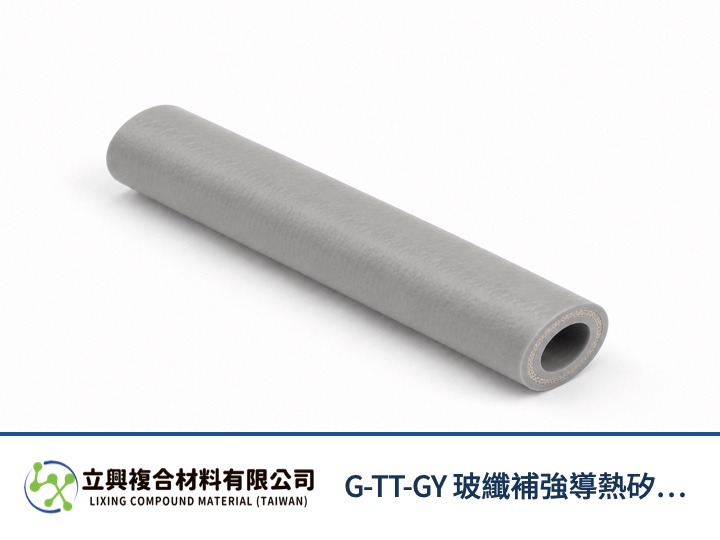
Slide the tube on and the device gains a silicone layer that insulates and conducts heat at the same time. The G-TT-GY fiberglass-reinforced thermal silicone tube product page describes it as combining thermal conductivity, electrical insulation and cushioning, for heat transfer and insulation between semiconductors and heat sinks.
Insulation data you can trace to a test standard
Resistivity of 10^12 Ω·cm is measured to ASTM D257 and breakdown voltage of ≥ 3 kV to ASTM D149, so a design review can check both against named methods. The page marks them as typical values and does not state the specimen wall thickness for the breakdown test, so confirm withstand voltage on samples at your drawing's wall thickness instead of converting the figure into a per-millimetre rating.
An annular fiberglass layer keeps the wall stable
A single ring of fiberglass cloth is embedded in the middle of the tube wall, which the product page says helps dimensional stability and pressure resistance. Wall thickness is offered from 5 to 10 mm. The silicone conforms to the part while the fiberglass ring holds the profile, so the wall is less likely to thin out when the sleeve is fitted.
Soft and slightly tacky, so it holds at low clamping force
With a hardness of 30–70 Shore 00, the wall is soft and compressible and conforms to the gap between component and heat sink. The tube is slightly tacky, so extra adhesive is usually unnecessary, and the page notes low thermal resistance even under low mounting pressure. For the low-pressure side of the story, see how the fiberglass-reinforced tube handles low-pressure thermal contact.
V-0 and a wide temperature range for the design review
The material carries a UL 94 V-0 flame rating and an operating range of -40 to 200°C. Both are material-level data for early screening; end-product safety approval and creepage distance still need their own verification. If your requirement is ESD grounding instead, a conductive silicone tube is the opposite choice, because G-TT-GY is built to insulate.
Where it fits
- Insulated heat dissipation for power transistors, MOSFETs, ICs and power modules
- Heat-generating parts that need insulation in communication equipment
- Memory chip and graphics card cooling modules
- Modules with high thermal conductivity needs and LCD backlight modules
- Fire-protection equipment
Why wall thickness and sleeve length change leakage resistance
Insulation through the tube wall can be estimated with the radial leakage resistance of a coaxial cylindrical insulator: R_ins = ρ · ln(r_o / r_i) / (2π · L). R_ins is the leakage resistance through the wall (Ω), ρ is volume resistivity (Ω·m; 1 Ω·cm equals 0.01 Ω·m), r_o and r_i are the outer and inner radii (m), and L is the sleeved length (m). A larger outer-to-inner radius ratio raises leakage resistance, while a longer sleeve adds parallel leakage paths and lowers it. The derivation is in OpenStax University Physics Volume 2, section 9.3, coaxial cable resistance example.
The model assumes a uniform insulator with mainly radial current, which suits DC steady-state comparisons. It ignores surface leakage at the tube ends, creepage distance and resistivity shifts with humidity and temperature, and it says nothing about breakdown; a wall with a fiberglass layer is not perfectly uniform. Treat the result as an engineering estimate, never as a product specification or withstand guarantee.
What to send with a sample request
- Component outline and the length to be sleeved
- Working voltage and the safety standard that applies
- Target wall thickness
- Operating temperature and how the part contacts the heat sink
Lixing Composite Materials Co., Ltd. does not offer online checkout. For samples or a specification consultation, contact us through the G-TT-GY product page or email yw@zh-lx.com, and we will check feasible specifications against your voltage and wall-thickness conditions.
#FiberglassReinforcedSiliconeTube #ElectricalInsulation #PowerDevices #PowerModules #ThermalSiliconeTube