
High-Temperature Conductive Cloth Tape: 80°C Long-Term Adhesion That Keeps EMI Grounding in Place
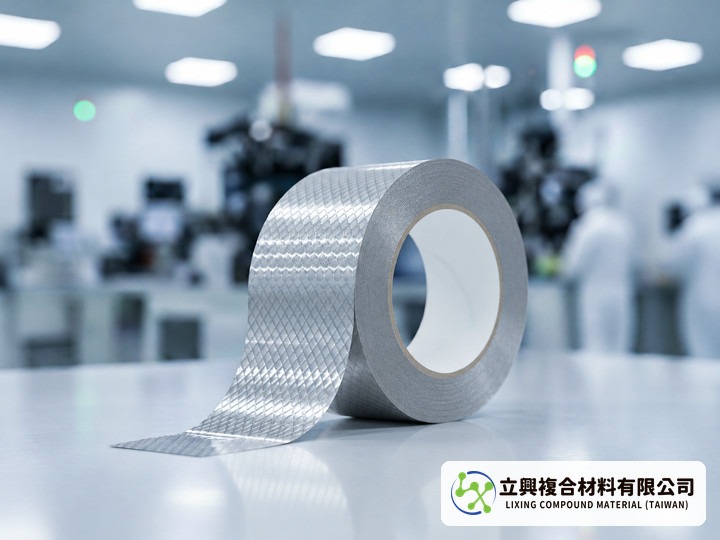
Grounding in a hot zone only works if the tape is still in place once the temperature climbs. According to the product page, Lixing LX-DDB conductive cloth tape holds its adhesion through long-term operation at 80°C, carries a 120°C short-term rating, lists a 180° peel strength of ≥ 1.3 kgf/in and a surface resistance of ≤ 100 mΩ. Send us the in-service temperature at the bond, the time spent near 120°C and the substrate material, and you can decide whether it fits your hot-zone grounding design.
Grounding stays put when the tape stays down
In an EMI design, conductive cloth tape links the shield can, the metal housing and the PCB ground point into one path. If any part of that path lifts, contact is lost. Each of the four advantages below comes back to the same thing: the tape keeps its bond when the assembly runs warm.
80°C long-term operation without loosening
Laptops and medical devices that run for hours sit at a steadily elevated internal temperature, so the tape has to hold day after day. The product page states that LX-DDB combines initial tack with long-term holding and stays stable in long-term operation at 80°C. The spec table also lists a holding power of 8 hours or more.
A 120°C short-term rating for local hot spots
Short temperature spikes at start-up or inside a tight enclosure are where adhesive bonds often start to let go. LX-DDB is rated for 120°C short-term exposure, which gives local hot spots some headroom. The page does not state how long the tape may stay at 120°C, so confirm it against your actual process time with Lixing.
Peel values you can put on a drawing
Purchasing and quality teams need numbers that can go into an approval sheet. The spec table lists a surface adhesion of ≥ 1.0 kg/in (PSTC-101) and a 180° peel strength of ≥ 1.3 kgf/in, ready for comparison with your current material; the full table is on the Conductive Cloth Tape Series product page. The test temperature for both values is not stated, so peel at elevated temperature needs its own test.
A soft substrate that wraps corners cleanly
Cable wraps and the corners of odd-shaped parts are where tape tends to lift. LX-DDB uses a 260T plain-weave conductive cloth substrate with a conductive acrylic adhesive. The product page describes the substrate as soft and easy to wrap and bend, suitable for custom die-cut shapes, with total thickness customizable on request.
Where it fits in hot zones
- Tight spaces near heat-generating components in phones and laptops, bonding a shield can or metal frame to ground.
- Inside the housing of medical equipment that runs for long periods, for EMI shielding and grounding.
- PCB ground points and cable wrapping, where the soft substrate follows corners and curves.
All three run warm and leave little room, and a lifted edge is hard to spot from outside. A surface resistance of ≤ 100 mΩ keeps the ground path short and direct. The product page does not give resistance at elevated temperature, so measure ground resistance once at the real operating temperature.
Why 120°C is a short-term rating: the Arrhenius equation
Ageing, oxidation and creep in an adhesive layer are largely thermally activated, and the Arrhenius equation describes how their rate depends on temperature:
k = A × exp(-Ea / (R × T))
- k: rate constant of a thermally activated process (units depend on the process)
- A: frequency factor, same units as k
- Ea: activation energy, J/mol
- R: ideal gas constant, 8.314 J/(mol·K)
- T: absolute temperature, K (°C + 273.15)
Temperature sits in the exponent. Going from 80°C (353.15 K) to 120°C (393.15 K) multiplies the rate of a thermally activated process, which is why a long-term operating temperature and a short-term rating are listed separately. The equation and variable definitions come from OpenStax Chemistry 2e, 12.5 Collision Theory.
Conditions and limits: the equation applies to processes dominated by one mechanism with no phase change in the temperature range. This product's Ea is not published, so it cannot give a lifetime or a peel value, and the viscoelastic softening of acrylic adhesive does not strictly follow this relationship. It is an engineering concept model, not a product specification or guarantee.
What to send with your inquiry
- The in-service temperature at the bond and how long it stays above 80°C
- The substrate and its finish, such as a metal housing, PCB copper or a plastic part
- Required width, total thickness and die-cut shape
- Whether ground resistance or peel should be measured at operating temperature
For laying out the ground path itself, see our conductive cloth tape grounding path checklist, which covers overlaps, contact faces and measurement points.
Conclusion
Grounding in a hot zone depends on tape that is still in place after the temperature rises. LX-DDB offers 80°C long-term holding, a 120°C short-term rating and peel values you can compare, which suits designs that need EMI grounding in a warm environment. Check the specifications on the Conductive Cloth Tape Series product page, or email yw@zh-lx.com to request samples or a specification consultation.
#ConductiveClothTape #HighTemperatureTape #EMIShielding #Grounding #Lixing