
FPC Lamination Buffer Pad for Clearer Pressure Transfer Decisions
FPC lamination needs the press force carried across the panel while release remains manageable after the cycle. The FPC Lamination Silicone Buffer Pad combines a PTFE release surface with a multilayer fluororesin-fiber composite; engineering and procurement teams should first check loaded area, the 280°C temperature rating, and 85–90 Shore A hardness, then confirm the stack with their own press and samples.
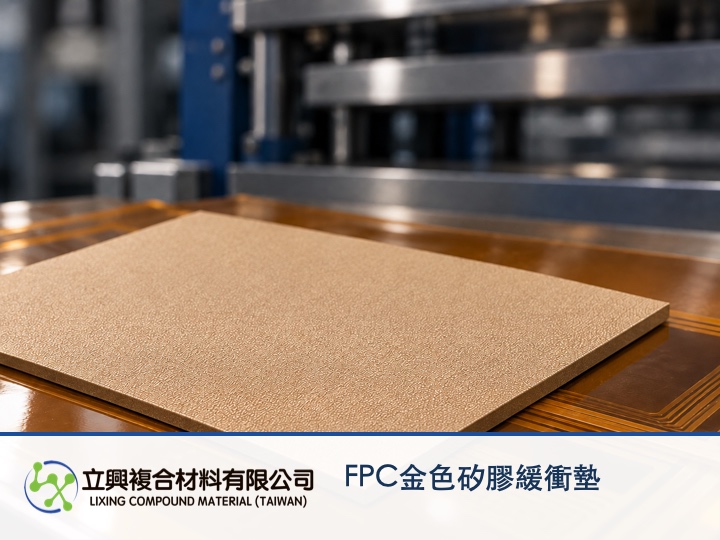
A gold sheet makes the lamination aid easy to identify
The rectangular gold sheet has a fine surface texture that distinguishes it from adjacent lamination aids. The official product page identifies a PTFE non-stick coating, while release decisions still depend on the observed surface condition after each cycle.
Temperature and hardness give buyers a defined starting point
The disclosed 280°C rating and 85–90 Shore A hardness help screen materials against a process window. Final approval still needs the actual thermal profile, press parallelism, panel size, and stack construction.
The composite construction supports pressure transfer and release
The product page describes fluororesin-coated high-strength fiber cloth with high-temperature, heat-conductive fluororesin in a multilayer composite. It is intended for PCB, FPC, rigid-flex, and IC-substrate lamination where cushioning and release are both required, while local pressure remains a system-level result.
Use P = F / A to read nominal average pressure
OpenStax defines pressure as P = F / A. P is average pressure in Pa, F is the normal force in N, and A is loaded area in m². The model is useful when force is approximately normal and area is known. It does not capture local peaks, viscoelastic response, surface unevenness, temperature gradients, or press nonuniformity, and it is not a product performance guarantee.
Turn published data into a testable sample condition
When comparing an FPC pad for lamination, share panel dimensions, press force, peak process temperature, stack construction, and release requirements with Lixing Composite Materials Co., Ltd. The official product data also lists pressure resistance above 45 kgf/cm²; verify local loading, surface condition, and reuse criteria on the actual equipment.
Give each lamination trial the same decision basis
The FPC Lamination Silicone Buffer Pad brings temperature resistance, hardness, pressure-transfer construction, and a release surface into one sheet. Review the product conditions to request a sample and specification consultation before qualifying it in your process.
#FPCLamination #SiliconeBufferPad #PCBManufacturing #PressureTransfer