
Copper Foil Self-Adhesive Tape Saves Space in Thin Electronic Assemblies
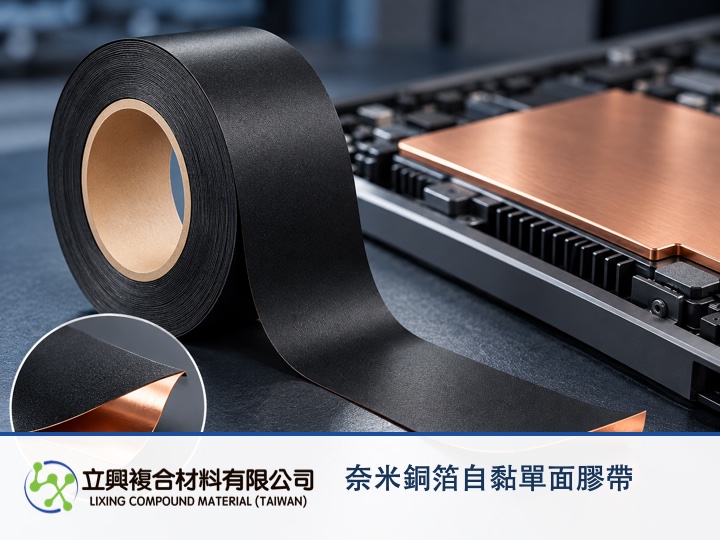
Copper Foil Self-Adhesive Single-Sided Tape can create a bonded heat path inside space-constrained smartphones, tablets, and precision electronic assemblies while limiting the material allowance in the stack. Procurement and process engineers can start with total thickness, substrate thickness, and bonding surface before defining the die-cut outline and sample conditions.
A thin structure fits thermal management into an existing stack
The official thickness and material options for the copper foil tape list total thickness from 0.03 ± 0.005 to 0.155 mm and substrate thickness from 0.009 to 0.07 mm. These ranges let engineers select a sample around the available clearance without treating a general heat-transfer model as a product guarantee.
The copper substrate and adhesive face combine fixing with a heat path
The official product page describes a copper substrate with a nano-carbon surface and a single-sided acrylic adhesive. Its flexible roll form supports thin bonding locations in smartphones, tablets, and precision electronics. Adhesion and thermal behavior still require validation with the selected grade and actual adherend.
Dimensional stability supports die-cut boundaries
The product page identifies dimensional stability, die cutting, and lamination as supported handling characteristics. Engineers can provide the outline, tolerance, and keep-out region, then use a die-cuttable thin copper foil tape sample to check edge lift and full adhesive contact.
An engineering model shows why thickness deserves a separate check
MIT gives the one-dimensional steady-state slab relation Rcond = L / (kA). Rcond is conduction thermal resistance in K/W; L is thickness along the heat-flow direction in m; k is thermal conductivity in W/(m·K); and A is area normal to heat flow in m². The model assumes a homogeneous slab, one-dimensional steady conduction, approximately constant properties, and no internal heat generation. It excludes adhesive and contact resistance, in-plane spreading, edge effects, and transient heating, so it supports engineering reasoning rather than a measured product result. Source: MIT 2.051 Heat Transfer Equation Sheet.
Bonding quality determines whether the thin material can work as intended
The product page calls for a clean, dry surface and avoiding contact with the adhesive after liner removal. For sampling, provide the available thickness, adherend, die-cut dimensions, operating temperature, and assembly pressure. Validate interface contact, adhesion, and EMI continuity in the real assembly, then review the official product data and sample conditions.
#CopperFoilTape #ThinElectronics #ThermalManagement #DieCutting