
What Is Atomic Orbital Hybridization?
Atomic orbital hybridization is an important concept in bonding theory used to explain the geometry of covalent bonds in molecules.
When an atom forms covalent bonds, its original orbitals, such as s, p, and sometimes d orbitals, are mathematically combined to form a set of equal-energy hybrid orbitals.
These hybrid orbitals have specific spatial orientations that allow stable, symmetric bonding with other atoms.
Hybridization is a mathematical treatment in quantum mechanics, not a literal physical mixing process. It helps explain experimentally observed molecular shapes and bond angles.
Common hybridization types include sp, sp², sp³, sp³d, and sp³d², associated respectively with linear, trigonal planar, tetrahedral, trigonal bipyramidal, and octahedral arrangements.
Hybridization explains structural features of methane (CH₄), ethylene (C₂H₄), acetylene (C₂H₂), and other molecules, providing a basis for understanding molecular geometry and bonding.
Why Use Hybrid Orbitals?
Ordinary s and p orbitals alone do not explain some molecular structures.
For example:
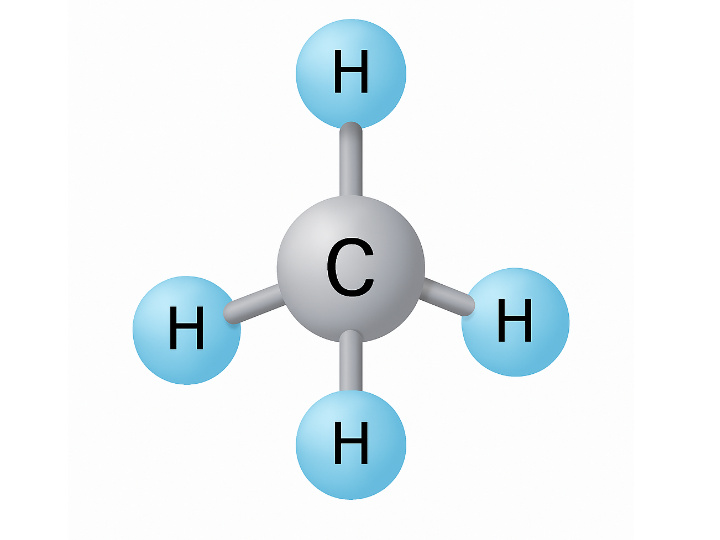
Methane, CH₄ has four equivalent C–H bonds with bond angles of approximately109.5° in a tetrahedral structure
Carbon originally has one 2s and three 2p orbitals. How can these form four equivalent bonds?
The hybridization model proposes that one 2s and three 2p orbitals combine to form four new sp³ hybrid orbitals arranged symmetrically in space, explaining the observed structure.
Common Hybridization Types
| Hybridization | Orbital Combination | Number of Orbitals | Molecular Geometry | Bond Angle | Typical Molecules |
|---|---|---|---|---|---|
| sp | s + 1p | 2 | Linear | 180° | BeCl₂, C₂H₂ |
| sp² | s + 2p | 3 | Trigonal planar | 120° | BF₃, C₂H₄ |
| sp³ | s + 3p | 4 | Tetrahedral | 109.5° | CH₄, NH₃, H₂O |
| sp³d | s + 3p + 1d | 5 | Trigonal bipyramidal | 90°/120° | PF₅ |
| sp³d² | s + 3p + 2d | 6 | Octahedral | 90° | SF₆ |
Examples
CH₄ (Methane): sp³ Hybridization
Carbon combines one 2s and three 2p orbitals to form four equal-energy sp³ hybrid orbitals
Each sp³ orbital overlaps with a hydrogen 1s orbital, forming four σ bonds
The molecular geometry is Tetrahedral, with bond angles of approximately 109.5°
C₂H₄ (Ethylene): sp² Hybridization
Each carbon forms three sp² hybrid orbitals, leaving one unhybridized p orbital
The sp² orbitals form σ bonds, while the unhybridized p orbitals overlap to form a π bond
The C=C bond therefore consists of one σ bond and one π bond
Molecular geometry:Trigonal planar
C₂H₂ (Acetylene): sp Hybridization
Each carbon forms two sp hybrid orbitals, leaving two p orbitals for π bonding
The C≡C bond consists of one σ bond and two π bonds
Molecular geometry:Linear
σ and π Bonds in Hybridization
| Bond Type | Origin | Characteristics |
|---|---|---|
| σ bond | Head-on overlap of hybrid or s orbitals | Strong and directional |
| π bond | Side-by-side overlap of unhybridized p orbitals | Weaker, more readily broken, and present in multiple bonds |
Key Points
Hybrid orbitals explain covalent bond directionality and bond angles
Hybridization type is closely related to molecular geometry
sp → linear; sp² → planar; sp³ → tetrahedral
π bonds in multiple bonds originate from unhybridized p orbitals