
UPDI Water in Semiconductor Manufacturing
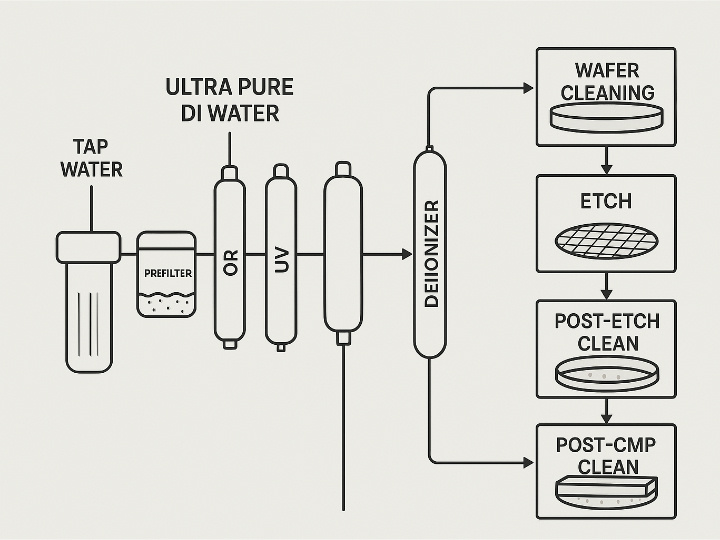
UPDI (ultrapure deionized water) is not a separate chemical substance; it refers to ultrapure deionized water, an essential cleaning and etching solvent in semiconductor manufacturing.
1. UPDI Applications in Semiconductor Manufacturing
In semiconductor manufacturing, UPDI is mainly used for cleaning and wet etching, as follows:
Wafer Cleaning
- Particle removal: removes fine particles and residues, such as photoresist residues, from wafer surfaces.
- Metal ion removal: metal impurities such as Cu²⁺ and Fe³⁺ affect chip yield; UPDI can dissolve these ions.
- Organic contamination removal: organic residues may affect subsequent deposition and photolithography.
Chemical Dilution
- UPDI dilutes strong acids and bases, such as HF, H₂SO₄, and NH₄OH, for wet etching or RCA cleaning.
Chemical Solution Preparation
- Used in RCA cleaning solutions (SC-1 and SC-2) to help remove organic matter and metal ions.
- Used with BOE (buffered oxide etch, HF + NH₄F) for SiO₂ etching.
- Used with KOH (potassium hydroxide) for silicon etching.
Post-CMP Rinsing
- Chemical mechanical polishing (CMP) leaves residual particles. UPDI removes them to prevent interference with subsequent deposition.
2. Chemical Reactions Associated with UPDI
UPDI does not directly participate in the reactions described here, but combining it with other process chemicals affects cleaning and etching:
(1) RCA Cleaning
UPDI is used to prepare SC-1 (NH₄OH + H₂O₂ + UPDI) to remove organic matter:
NH4OH+H2O2+Si→(NH4)2SiO3+H2ONH_4OH + H_2O_2 + Si \rightarrow (NH_4)_2SiO_3 + H_2O
UPDI is also used in SC-2 (HCl + H₂O₂ + UPDI) to remove metal ions:
HCl+H2O2+Fe3+→FeCl3+H2OHCl + H_2O_2 + Fe^{3+} \rightarrow FeCl_3 + H_2O
(2) BOE (Buffered Oxide Etch)
UPDI dilutes HF + NH₄F to etch SiO₂ insulating layers:
SiO2+6HF→H2SiF6+2H2OSiO_2 + 6HF \rightarrow H_2SiF_6 + 2H_2O
(3) KOH Wet Etching of Silicon
UPDI is used to prepare KOH solution for silicon etching:
Si+2OH−+H2O→Si(OH)2O22−+2H2Si + 2OH^- + H_2O \rightarrow Si(OH)_2O_2^{2-} + 2H_2
3. UPDI vs. Conventional Deionized Water
| Comparison | UPDI (ultrapure water) | Conventional deionized water |
|---|---|---|
| Resistivity (MΩ·cm) | 18.2 MΩ·cm (very high purity) | 0.1–1 MΩ·cm (may contain impurities) |
| Metal Ion Concentration (ppt level) | <1 ppt (very low metal contamination) | ppm level; may affect chip processing |
| Particle Contamination | Very low, using nanoscale filtration | May contain particles that affect yield |
| Applications | Semiconductor process cleaning and wet etching | General industrial use |
4. Conclusion
UPDI is ultrapure deionized water, rather than a chemical reagent. In semiconductor manufacturing, it is mainly used for cleaning, etching, and chemical dilution to keep wafer surfaces clean. It supports RCA cleaning, BOE, KOH etching, and related processes, indirectly supporting chemical reactions and improving chip manufacturing yield.