
Conductive Pathway Theory
Conductive pathway theory examines the formation of conductive paths in composites, particularly the relationship between electrical properties and conductive fillers. It was first proposed by Kemp and later refined by Parkinson, Iabgood, Bulgin, and others.
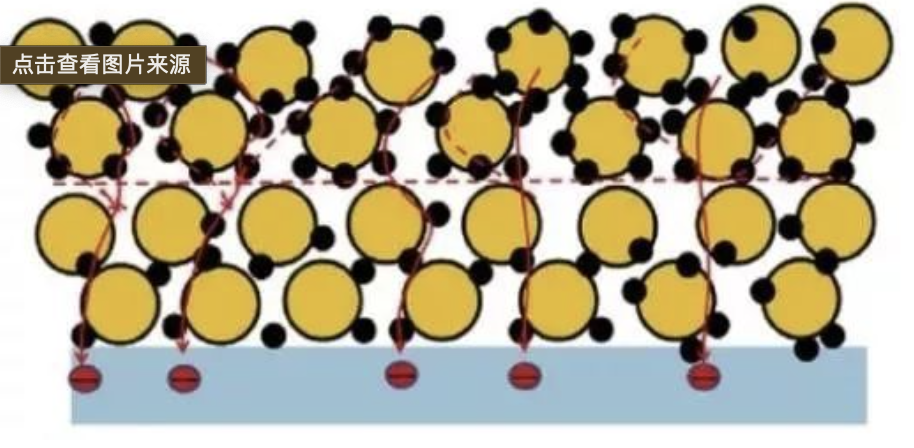
Conductive paths generally form when particles contact one another in a continuous chain-like network or are separated by less than 100 nm. More contacting particles, denser networks, and shorter gaps increase composite conductivity.
Particles that form large aggregates more readily create continuous conductive chains. Carbon black, with its small particle size and high specific surface area, readily forms such networks. Researchers use the average particle contact number, m, to describe network formation. For spherical particles, networks gradually form as m ranges from 2 to 12.
Conductivity also depends on particle contact resistance, gaps, and the number of contacts. Some researchers observed conduction before continuous chains formed or when gaps remained relatively large. For example, electron microscopy work by Polley and Boonstra showed conduction even without close carbon-black contacts, including after stretching conductive rubber. Conventional conductive pathway theory has difficulty explaining these observations.